Football entered a new tactical era at the turn of the 21st century. The rigid formations of earlier generations were giving way to systems in which possession, pressing, movement and space became just as important as the positions printed on a team sheet.
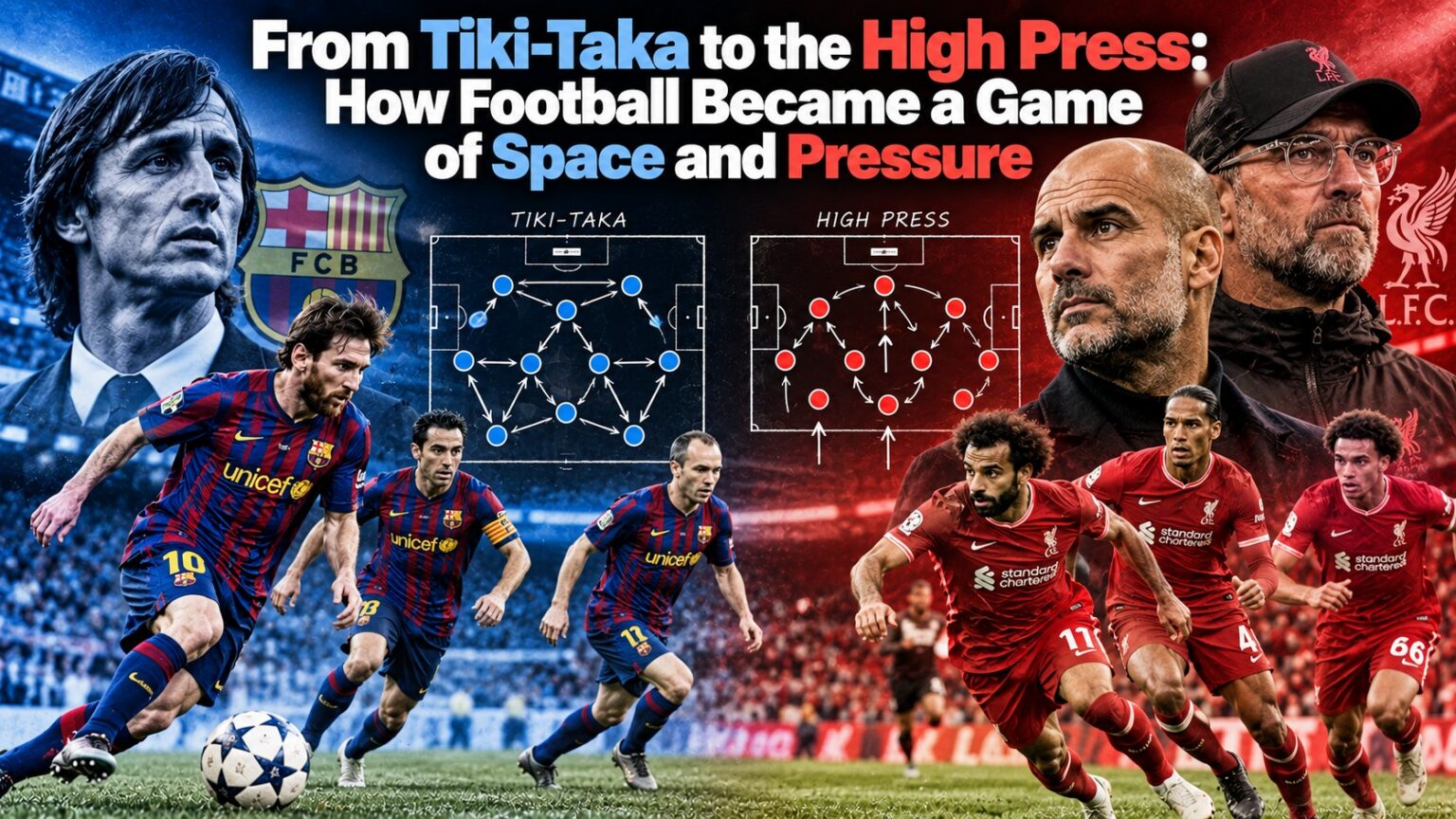
At the centre of this revolution was Tiki-Taka, the possession-based style associated with Barcelona and the Spanish national team. But as teams learned how to defend against possession football, another tactical response emerged: the high press.
From Johan Cruyff’s Barcelona to Pep Guardiola’s greatest teams, and from Arrigo Sacchi’s pressing principles to Jürgen Klopp’s gegenpressing, modern football increasingly became a contest for space and time.
The objective was no longer simply to decide where players should stand. It was to decide where the opposition could play, how quickly they could think and what would happen immediately after possession changed hands.
The End of Fixed Positions
The tactical ideas of Catenaccio and Total Football had already demonstrated that football positions did not have to be completely fixed.
By the late 20th century, coaches were increasingly interested in controlling the spaces between players rather than simply assigning each player a position.
The emergence of pressing and possession football accelerated that change. A midfielder might drop between defenders to receive the ball. A full-back might move into midfield. A winger might move inside. A centre-back might carry the ball forward.
The formation on paper remained important, but the team’s shape in possession and out of possession could look completely different.
What Is Tiki-Taka?
Tiki-Taka is generally used to describe a style of football based around short passing, possession, movement and creating numerical advantages through positioning.
The term became strongly associated with the Spanish national team and Barcelona during the late 2000s and early 2010s, although many of its underlying principles had much deeper roots.
Rather than simply passing the ball for the sake of possession, the objective was to use the ball to control the game, move the opposition around and create openings.
Every pass could change the position of the defenders. Every movement could create a new passing lane.
Johan Cruyff’s Barcelona Revolution
The foundations for Barcelona’s modern possession philosophy were laid decades earlier by Johan Cruyff.
As a player, Cruyff had been one of the defining figures of Total Football. As Barcelona manager between 1988 and 1996, he helped establish a footballing philosophy based on possession, technical quality, positional structure and intelligent movement.
Cruyff’s Barcelona won four consecutive Spanish league titles between 1990-91 and 1993-94 and became one of Europe’s most influential teams.
More importantly, the ideas developed during the Cruyff era became part of Barcelona’s footballing culture and would later influence a new generation of coaches and players.
La Masia and the Barcelona Philosophy
Barcelona’s academy, La Masia, became an important part of this philosophy.
Young players were taught not simply how to control and pass the ball, but how to understand space, positioning and the movements of teammates.
This helped produce a generation of technically exceptional players who were comfortable receiving the ball under pressure and making quick decisions in tight spaces.
Among them was a diminutive midfielder who would eventually become the centre of Barcelona’s most successful modern team: Xavi Hernández.
Alongside Xavi came players such as Andrés Iniesta, Sergio Busquets, Carles Puyol, Gerard Piqué and, later, Lionel Messi. Together they provided the technical foundations for an extraordinary period of success.
Pep Guardiola Takes Tiki-Taka to Another Level
When Pep Guardiola became Barcelona manager in 2008, he inherited a club with a well-established footballing philosophy. He then pushed many of its principles to another level.
Guardiola’s Barcelona team became famous for dominating possession, creating passing triangles and using positional rotations to create space.
The team also pressed immediately after losing the ball. This was crucial because possession was not treated as an isolated attacking phase. Losing the ball triggered the next tactical phase.
Barcelona attempted to win it back before the opposition could escape.
The 2008-09 Barcelona Treble
Guardiola’s first season demonstrated just how effective the philosophy could become.
Barcelona won La Liga, the Copa del Rey and the UEFA Champions League in the 2008-09 season, becoming the first Spanish club to win the treble of league, domestic cup and European Cup/Champions League.
The team combined patient possession with aggressive pressing and devastating attacking movement.
It was not possession for possession’s sake. Barcelona used the ball to control where the opposition could defend and then attacked the spaces that appeared.
The Importance of the False Nine
One of Guardiola’s most famous tactical decisions came in the 2009 Champions League semi-final against Chelsea.
Barcelona used Samuel Eto’o and Thierry Henry in wide attacking positions while Lionel Messi moved into a central role that increasingly resembled a false nine.
Rather than remaining on the shoulder of the last defender, Messi could drop into midfield. If a centre-back followed him, space opened behind the defensive line. If the defender stayed in position, Messi could receive between the lines.
The tactic demonstrated one of the fundamental principles of modern positional play: movement can create space without the ball ever being passed into that space.
Spain and the Golden Generation
The principles associated with Barcelona also became central to Spain’s greatest period of international success.
Spain won UEFA Euro 2008, the 2010 FIFA World Cup and UEFA Euro 2012, becoming the first men’s national team to win three consecutive major international tournaments across those competitions.
The Spanish side built its game around possession, technical quality and short passing, with Barcelona players including Xavi, Iniesta, Sergio Busquets, Carles Puyol and Gerard Piqué forming important parts of the team.
The 2010 World Cup final against the Netherlands ended with Andrés Iniesta scoring the winning goal in extra time.
But Possession Had a Problem
The success of possession football created its own tactical problem.
If a team wanted to control the game through short passing, what was the best way to stop it?
One answer was to defend deeper and deny space behind the defensive line.
Another was much more aggressive: do not let the possession team build its attacks in the first place.
The Rise of the High Press
The high press attempts to win the ball close to the opponent’s goal rather than waiting for the opposition to enter your own half.
For the press to work, the team must move forward together. The forwards close down defenders, midfielders move up behind them and the defensive line pushes higher to reduce the space between the lines.
The aim is to make the pitch smaller for the team in possession.
When executed successfully, the pressing team can win the ball in an advanced position and attack before the opposition has time to reorganise.
Pressing Is About Triggers
Modern pressing is not simply eleven players running towards the ball.
Elite teams identify specific pressing triggers that signal when the whole team should accelerate its defensive pressure.
A poor first touch, a backwards pass, a pass towards the touchline or a goalkeeper receiving the ball can all become opportunities to press.
The objective is to force the opponent into making a predictable decision and then close the available passing options.
Jürgen Klopp and Gegenpressing
One of the managers who pushed pressing to the forefront of modern football was Jürgen Klopp.
Klopp developed his reputation at Borussia Dortmund, where his teams combined aggressive pressing with rapid attacking transitions.
The German term Gegenpressing is commonly translated as counter-pressing. Rather than immediately retreating after losing possession, the team attempts to win the ball back at once.
The logic is simple: immediately after losing the ball, the opposition may be poorly positioned to defend because several players have just been involved in the attack.
The moment of losing possession can therefore become an attacking opportunity.
Klopp’s Borussia Dortmund
Klopp’s Dortmund won back-to-back Bundesliga titles in 2010-11 and 2011-12.
The team became known for its intensity, vertical attacking style and ability to recover the ball quickly.
Players such as Robert Lewandowski, Mario Götze, Shinji Kagawa and Marco Reus gave Dortmund the technical quality to turn defensive recoveries into rapid attacks.
Klopp’s philosophy provided a different answer to the possession dominance of teams such as Barcelona: instead of trying to keep the ball away from the opposition, win it back before they can use it.
Guardiola vs Klopp
The contrasting philosophies of Guardiola and Klopp became one of the defining tactical stories of modern football.
| Guardiola | Klopp |
|---|---|
| Possession and control | Pressing and transition |
| Positional play | Gegenpressing |
| Create space through positioning | Exploit space immediately after winning the ball |
| Patient circulation | Rapid vertical attacks |
| Control through the ball | Control through pressure |
Yet the distinction is not absolute.
Guardiola’s teams press aggressively after losing possession, while Klopp’s teams also need possession and positional structure to attack effectively.
Modern elite football increasingly combines ideas that were once treated as separate philosophies.
The Modern Full-Back
The evolution of positional play also transformed the role of the full-back.
Traditionally, full-backs were primarily defensive players who provided width when their team attacked. Modern systems have expanded the role dramatically.
Some full-backs push high and provide width. Others move inside into midfield, creating an extra player in central areas.
These inverted full-backs can help a team control possession while also providing protection against counter-attacks.
Football Becomes a Game of Space
The common thread running through modern tactics is the control of space.
Tiki-Taka attempts to create space through passing and movement. Positional play attempts to occupy the right spaces to create numerical or positional advantages. High pressing attempts to remove the opponent’s available space.
Gegenpressing attempts to exploit the moment when the opposition is most vulnerable: immediately after losing possession.
Football has therefore become increasingly focused on what happens between the traditional positions.
From Formations to Phases
A modern team can no longer be fully described by a single formation.
A side listed as 4-3-3 might build up in a 3-2-5, defend in a 4-4-2 and press in a completely different shape.
This is one of the biggest differences between modern football and the early Pyramid era.
The formation is now often a starting point rather than a fixed structure. Teams change shape depending on whether they have possession, are defending, pressing or transitioning between phases.
The Tactical Evolution in Numbers
| Era | Key Idea | Tactical Objective |
|---|---|---|
| 1990s | Pressing and positional structure | Control space and disrupt build-up |
| Late 2000s | Tiki-Taka | Control games through possession and movement |
| 2010s | Gegenpressing | Win the ball immediately after losing it |
| 2010s-2020s | Positional play | Create numerical and positional advantages |
| Modern era | Hybrid systems | Change shape between different phases of play |
Why Tiki-Taka and the High Press Still Matter
The great tactical revolution of the modern era was not the invention of one new formation. It was the increasing importance of space, movement, pressure and transitions.
Teams now analyse where opponents receive the ball, which passing lanes are available, how quickly the ball can be recovered and how the team’s shape should change from one phase to another.
The result is a game in which tactical decisions can change from second to second.
Football Formations FAQs
What is Tiki-Taka in football?
Tiki-Taka is a possession-based style of football associated particularly with Barcelona and Spain. It emphasises short passing, movement, positional structure and using possession to control space.
What is a high press in football?
A high press is a defensive strategy in which a team attempts to win the ball high up the pitch, often close to the opponent’s goal, rather than retreating into a deep defensive block.
What is gegenpressing?
Gegenpressing, or counter-pressing, is the tactic of attempting to regain possession immediately after losing the ball. It is strongly associated with Jürgen Klopp’s teams, although the broader principle has much deeper tactical roots.
Who invented Tiki-Taka?
Tiki-Taka was not invented by a single manager. Its principles developed from earlier possession and positional-play traditions, including the ideas associated with Johan Cruyff and Barcelona. Pep Guardiola later developed those principles further during his time as Barcelona manager.
Why do modern football teams change formation during matches?
Modern teams often use different shapes depending on whether they are attacking, defending, pressing or transitioning. A team may therefore have one formation on the team sheet but several different structures during a match.
The Evolution of Football Continues
From the 2-3-5 Pyramid to the WM, from Catenaccio to Total Football and from Tiki-Taka to gegenpressing, football’s tactical history is a story of problems and solutions.
Every successful tactical idea eventually forces opponents to adapt. The result is a continuous cycle of innovation that has transformed the way football is played.
In the final chapter of The Evolution of Football, we turn our attention to the people behind those ideas: the managers who changed football, from Herbert Chapman and Rinus Michels to Johan Cruyff, Arrigo Sacchi, Pep Guardiola and beyond.