
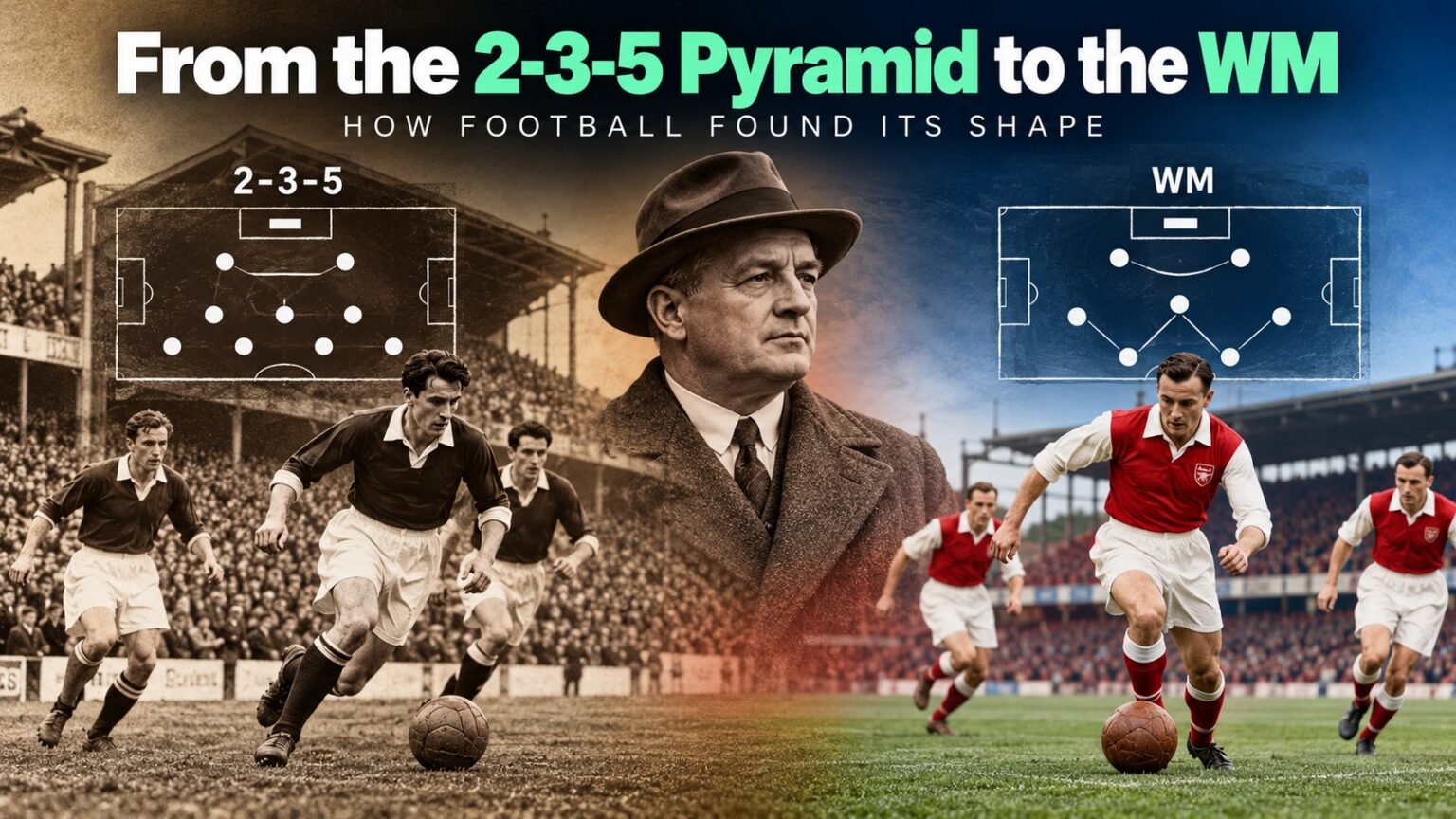
Football formations have changed dramatically over the history of the game. The modern 4-3-3, 4-2-3-1 and 3-4-3 may look familiar today, but football was once dominated by a formation that placed five forwards across the attacking line.
The 2-3-5 Pyramid was the defining tactical system of football’s early decades. It shaped the way teams attacked, defended and passed the ball before a major change to the offside law in 1925 forced managers to rethink how their teams were organised.
That tactical revolution produced the WM formation, most famously associated with Arsenal manager Herbert Chapman and England international Charlie Buchan. The WM helped establish the idea that football could be deliberately structured into different phases of attack and defence.
The Birth of the 2-3-5 Pyramid
In football’s earliest decades, there was little agreement about how eleven players should be organised. Teams experimented with heavily attacking systems, including formations with six, seven or even eight forwards.
As the game became more organised during the late 19th century, the 2-3-5 formation emerged as the dominant tactical system. Its shape was often described as a Pyramid because the players appeared to form increasingly wider lines as they moved towards the attack.
Two full-backs formed the defensive line, three half-backs operated in midfield and five forwards led the attack.
What Was the 2-3-5 Formation?
The traditional Pyramid consisted of:
| Position | Role |
|---|---|
| Goalkeeper | Protected the goal |
| Right-back | Defensive player on the right |
| Left-back | Defensive player on the left |
| Right half | Supported defence and attack |
| Centre half | Central link between defence and attack |
| Left half | Supported defence and attack |
| Outside-right | Wide attacking player |
| Inside-right | Attacking midfielder/forward |
| Centre-forward | Main central striker |
| Inside-left | Attacking midfielder/forward |
| Outside-left | Wide attacking player |
Unlike many modern formations, the Pyramid was built around a clear attacking emphasis. Five players were positioned in the forward line, with the two inside-forwards operating between the wide players and the centre-forward.
Why Did Teams Play With Five Forwards?
Early football was fundamentally different from the modern game. Passing was developing, tactical systems were less sophisticated and the rules governing offside strongly influenced how attackers could position themselves.
The five-man forward line gave teams plenty of attacking options. Wingers could stretch the opposition while the inside-forwards linked play with the centre-forward.
The three half-backs were also crucial. Rather than being purely defensive midfielders in the modern sense, they were expected to support both sides of the game and help connect the back line with the forwards.
The Pyramid and the Rise of Passing Football
The development of combination play gradually changed how the Pyramid was used.
Instead of relying almost entirely on individual dribbling, teams increasingly used short passing and movement to progress the ball. Players began to understand that maintaining their positions could create passing options and space for teammates.
The formation therefore became more than a diagram on paper. It provided a framework for how players could combine with one another.
Football’s Great Tactical Problem: Offside
The Pyramid’s dominance was eventually challenged by one of football’s most important rules: offside.
Before 1925, an attacking player generally needed three opposing players between himself and the goal line to remain onside. The rule made it possible for defenders to push forward together and catch attackers offside.
Defensive teams became increasingly capable of using the offside trap to restrict attacking space. The Football Association subsequently introduced a major change for the 1925-26 season, reducing the requirement from three defending players to two.
The change had an immediate tactical impact. Attackers suddenly had more space behind the defensive line, forcing teams to reconsider how they protected the area in front of goal.
The 1925 Offside Law Changes Everything
The new law came into effect at the beginning of the 1925-26 season. At Highbury on 29 August 1925, Herbert Chapman took charge of Arsenal for the first time as Tottenham Hotspur visited in the opening game of the campaign.
It was an extraordinary moment in football history. Chapman was beginning his Arsenal reign, Charlie Buchan was making his debut for the club, and the new offside law was being used in competitive football for the first time.
Tottenham won the match 1-0, but the tactical consequences of the new law would prove far more significant than the result.
Herbert Chapman and the Search for a New Formation
Herbert Chapman was already one of the most innovative managers in English football. After winning major honours with Huddersfield Town, he moved to Arsenal in 1925 with the club looking for a transformation.
Chapman recognised that the new offside law created a tactical problem. If attackers could exploit the additional space, simply continuing to play the traditional 2-3-5 could leave teams vulnerable.
Charlie Buchan, the experienced England international who had joined Arsenal alongside Chapman, played an important role in developing the solution. The idea was to move the centre-half deeper and create a third defensive player who could organise the defence and operate the offside trap.
Chapman had also experimented with defensive adaptations during his time at Huddersfield, so the evolution of the system was not the work of one person alone. It was the product of managers and players adapting to a changing set of rules and tactical problems.
The Birth of the WM Formation
The solution was a dramatic reshaping of the Pyramid.
Instead of two full-backs and an advanced centre-half, the new system placed the centre-half deeper between the two full-backs. One of the inside-forwards also dropped deeper to provide a link between midfield and attack.
The resulting shape became known as the WM formation.
When represented on a tactics board, the defensive and midfield lines created the shape of a W, while the attacking players formed an M.
It could be described broadly as a 3-2-2-3 shape, although the exact positioning of players varied depending on how a particular team interpreted the system.
How the WM Worked
The great strength of the WM was that it provided greater defensive protection without completely abandoning the attacking principles of the Pyramid.
The deeper centre-half became a key defensive organiser. The two full-backs could defend more narrowly, while the half-backs had clearly defined responsibilities in front of them.
Further forward, one of the inside-forwards could drop into a linking role, helping connect midfield with the front three.
The system therefore created a much clearer division between defensive and attacking responsibilities.
Arsenal and the Tactical Revolution
Arsenal became the most famous British exponent of the WM under Chapman.
The club’s tactical development took time. The new system was refined through matches, player experimentation and changes in personnel. Herbert Roberts eventually became an important figure in the deep centre-half role, while players such as Alex James helped make the attacking structure work.
Arsenal eventually turned Chapman’s tactical ideas into trophies. The club won the FA Cup in 1930 and then the First Division title in 1930-31, establishing itself as one of the dominant forces in English football.
From the Pyramid to the Modern Formation
The move from 2-3-5 to WM was not simply a change of numbers. It represented a fundamental change in how football teams thought about space.
The Pyramid was heavily attack-oriented. The WM introduced a greater emphasis on defensive structure, positional discipline and the relationship between different areas of the pitch.
Over the following decades, the WM would itself evolve. Different countries and managers adapted the system, gradually producing formations such as 4-2-4 and 4-3-3.
Those systems would eventually lead to the tactical developments explored later in this series, from Catenaccio and Total Football to Tiki-Taka, pressing and positional play.
Football Formation Timeline
| Period | Formation / System | Key Development |
|---|---|---|
| Late 19th century | Early attacking formations | Teams experimented with heavily attacking systems |
| Late 19th / early 20th century | 2-3-5 Pyramid | The dominant tactical structure |
| 1925 | WM begins to emerge | Offside law changes from three defenders to two |
| 1930s-1940s | WM | Defensive structure becomes increasingly important |
| 1950s | 4-2-4 | Four-man defensive structures become more prominent |
| Later 20th century | 4-3-3, 4-4-2 and others | Greater emphasis on midfield structure and tactical flexibility |
Why the 2-3-5 Pyramid Still Matters
The 2-3-5 may look strange to a modern football supporter, but many of the game’s basic positional concepts can be traced back to it.
The idea of using width, central combinations, midfield support and coordinated movement between different lines remains central to football today.
Most importantly, the story of the Pyramid shows that football formations are rarely permanent. Changes in the laws of the game, the qualities of players and the ideas of managers continually force teams to adapt.
Football Formations FAQs
What was the 2-3-5 formation?
The 2-3-5, also known as the Pyramid formation, used two full-backs, three half-backs and five forwards. It was the dominant formation in football during the late 19th and early 20th centuries.
Why was the 2-3-5 called the Pyramid?
The formation was called the Pyramid because of the way the players were arranged on the pitch, with two defenders, three half-backs and five forwards creating a pyramid-like shape.
What changed the 2-3-5 formation?
The 1925 change to the offside law was a major catalyst. The number of defending players required between an attacker and the goal was reduced from three to two, creating more attacking space and encouraging tactical changes.
Who developed the WM formation?
The WM formation is most closely associated with Herbert Chapman and Arsenal, although its development involved several players and tactical ideas rather than being the invention of one individual. Charlie Buchan played an important role in discussing the tactical response to the 1925 offside change.
What formation replaced the 2-3-5?
The 2-3-5 gradually evolved into systems including the WM and, later, formations such as 4-2-4 and 4-3-3. Football did not switch from one universal formation to another overnight; different systems coexisted and evolved in different countries and teams.
The Evolution of Football Continues
The journey from the 2-3-5 Pyramid to the WM was one of football’s first great tactical revolutions. But it was only the beginning.
In the next chapter of The Evolution of Football, we move into the tactical battles of the mid-20th century, exploring Catenaccio, Total Football and the revolutionary ideas that changed the relationship between attack and defence.