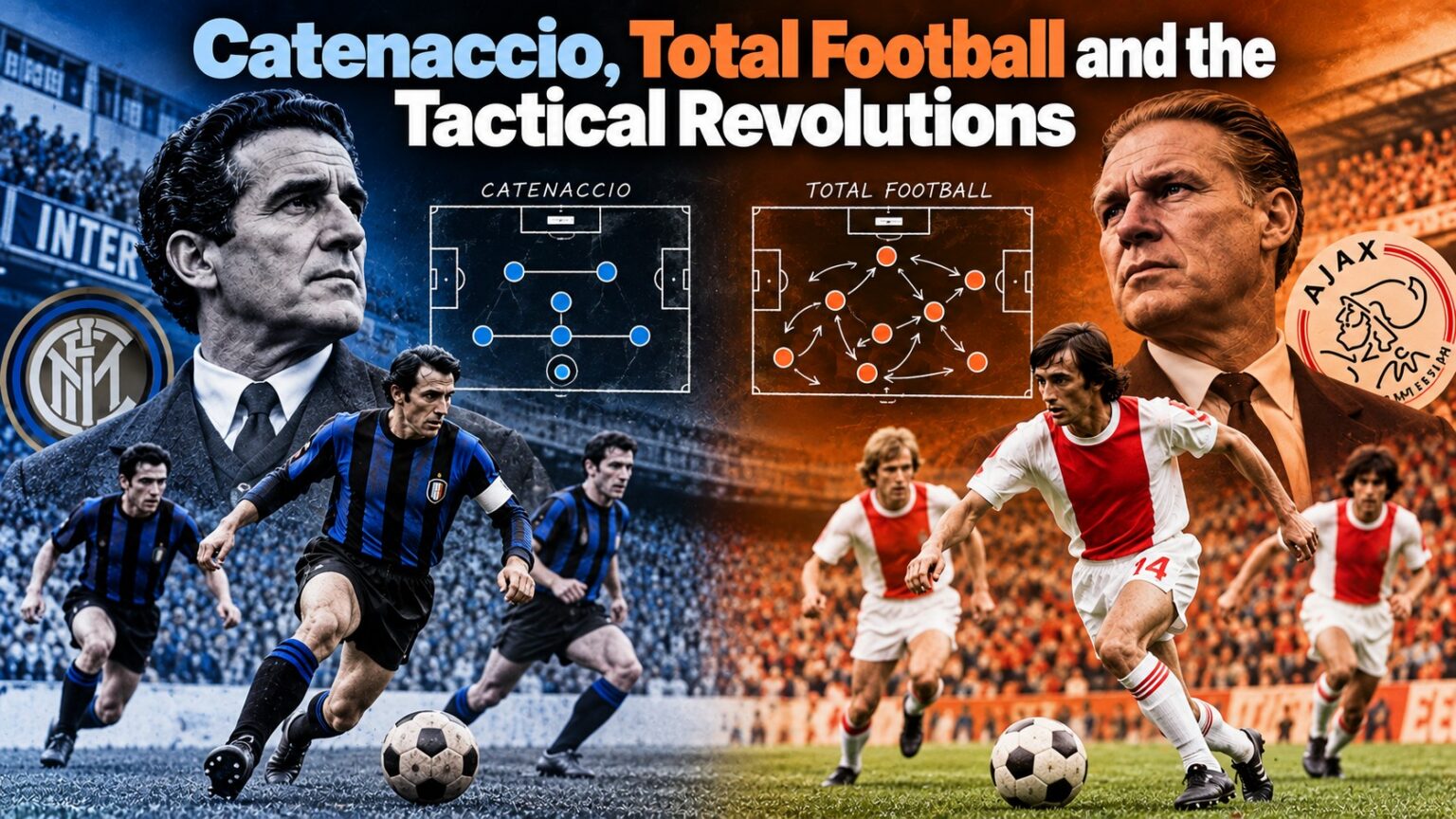
Football’s tactical evolution has never been a straight line. Every new system creates a problem for the opposition, and every problem invites another tactical response. In the 1960s and 1970s, that process produced two of the most influential football philosophies in history: Catenaccio and Total Football.
At first glance, they appeared to represent completely different ideas. Catenaccio became associated with defensive organisation, man-marking, a sweeper and rapid counter-attacks. Total Football emphasised movement, positional interchange, pressing and the ability of players to operate in different areas of the pitch.
Yet both systems were built around the same fundamental idea: control space.
The story of Catenaccio and Total Football is therefore not simply a battle between defence and attack. It is the story of football becoming increasingly sophisticated, as managers searched for new ways to control the pitch and exploit the weaknesses of their opponents.
The Tactical Revolution After the WM
By the middle of the 20th century, the WM formation had already transformed football. The old 2-3-5 Pyramid had evolved into a more structured system in which defensive organisation and positional discipline were increasingly important.
But the WM was not the end of tactical evolution.
Across Europe and South America, coaches were experimenting with different ways of defending, attacking and controlling space. Some teams concentrated on defensive security before launching fast counter-attacks. Others looked for greater freedom of movement and collective attacking combinations.
Two of the most influential ideas to emerge from this period were Catenaccio and Total Football.
What Was Catenaccio?
Catenaccio is an Italian word meaning door-bolt or lock, an appropriate description for a tactical philosophy built around defensive security.
The system is most closely associated with Italian football, although its origins were influenced by earlier tactical ideas developed elsewhere, particularly the Swiss Verrou system associated with Karl Rappan.
The defining feature was the use of a sweeper, or libero, positioned behind the main defensive line. Rather than being assigned to mark one particular opponent, the sweeper could cover behind the defenders and deal with attackers who escaped their markers.
In front of the sweeper, defenders could use tight man-marking. The objective was to deny the opposition space, disrupt their attacking combinations and make it extremely difficult to create clear chances.
How Did Catenaccio Work?
Catenaccio was not simply about putting ten players behind the ball.
Its effectiveness came from the relationship between defensive organisation and transition. Once possession was recovered, the team could move forward quickly while the opposition was still reorganising.
The sweeper provided insurance behind the defensive line. Man-markers concentrated on individual opponents. The midfield worked to restrict passing options, while the attacking players looked for opportunities to exploit the space left by an advancing opponent.
In other words, Catenaccio was designed not only to prevent goals, but to create the conditions for dangerous counter-attacks.
Helenio Herrera and Inter Milan
The manager most closely associated with the classic form of Catenaccio was Helenio Herrera.
Herrera took charge of Inter Milan in 1960 and developed a team renowned for its organisation, discipline and ability to punish opponents on the counter-attack.
His Inter side became one of the defining teams of the 1960s. With players including Armando Picchi, Giacinto Facchetti, Luis Suárez and Sandro Mazzola, Inter combined defensive structure with speed and intelligence in attack.
Inter won the European Cup in 1964 and retained it in 1965. The victories established Herrera’s team as one of the most successful and influential examples of the defensive counter-attacking philosophy.
The Libero: Defender or Playmaker?
One of the most fascinating features of the libero was that the player was not simply a last line of defence.
With no direct opponent to mark, the sweeper could read the developing attack, cover teammates and then step forward with the ball after possession was recovered.
This created an unusual hybrid role. The libero was a defender, but could also become the first player responsible for launching the attack.
Later versions of the role would become even more creative. Players such as Franz Beckenbauer demonstrated how a sweeper could carry the ball into midfield and influence the game from deep.
Catenaccio Was More Than Defence
One of the common misconceptions about Catenaccio is that it was simply an ultra-defensive system.
In reality, the philosophy depended heavily on the transition from defence to attack. Once the ball was won, the team needed players capable of moving forward quickly and accurately.
The counter-attack was therefore not an afterthought. It was an essential part of the system.
This distinction is important because the same principle remains visible in modern football. Teams that defend compactly before attacking at speed are still using a tactical concept that has roots in these earlier systems.
The Rise of Total Football
While Italian football was refining defensive organisation, a very different tactical philosophy was developing in the Netherlands.
Total Football became associated with the idea that players should be capable of moving into different positions while maintaining the team’s overall structure.
If one player left his position, another could occupy the space he had vacated. Positions were therefore not fixed in the traditional sense. The team could constantly change shape while remaining organised.
The concept demanded technically gifted players who understood space, movement and the responsibilities of their teammates.
Rinus Michels: The Architect of Total Football
The central figure in the development of Total Football was Dutch coach Rinus Michels.
Michels developed his ideas at Ajax during the 1960s, building a team that could press opponents, maintain possession and constantly change its attacking shape.
His Ajax side won the European Cup in 1971, beginning a remarkable run in which the club won the competition three times in succession between 1971 and 1973.
Michels later took charge of the Netherlands national team, where his tactical ideas became central to the Dutch team’s famous 1974 World Cup campaign.
Johan Cruyff: The Player Who Made It Possible
If Michels was the architect, Johan Cruyff became the player who could bring the philosophy to life.
Cruyff was not simply a centre-forward who waited for chances in the penalty area. He constantly moved into different areas of the pitch, dragging defenders out of position and creating space for teammates.
When Cruyff moved away from the central attacking position, another player could exploit the space he left behind. The result was a constantly changing attacking structure that made traditional man-marking extremely difficult.
This was one of the key principles of Total Football: move the player and you move the defender.
What Made Total Football Different?
Total Football was based on several interconnected principles:
- Positional interchange: players could move between positions while teammates filled the spaces they left.
- Pressing: the team attempted to win the ball back quickly after losing possession.
- High defensive line: the team compressed the playing area by pushing defenders further up the pitch.
- Technical ability: players needed the skill to operate comfortably in different areas.
- Movement: constant movement created passing options and disrupted defensive organisation.
- Collective responsibility: attacking and defensive duties were shared across the team.
The result was a team that could appear to change formation from one moment to the next without losing its underlying structure.
Ajax and the European Cup Revolution
Ajax became the laboratory in which Michels’ ideas were refined.
The club’s 1970s team combined technical quality with an extraordinary understanding of space. Players were expected to recognise when to move, when to hold their position and when to cover for a teammate.
Ajax won the European Cup in 1971, 1972 and 1973. The team was not simply successful; it demonstrated a different way of thinking about how eleven players could operate collectively.
The success of Ajax helped spread these tactical ideas beyond the Netherlands and influenced coaches across Europe.
The Netherlands at the 1974 World Cup
Total Football reached a global audience at the 1974 World Cup in West Germany.
The Netherlands, managed by Michels and led by Cruyff, produced one of the tournament’s most memorable tactical performances.
The Dutch side pressed aggressively, moved the ball quickly and constantly changed positions. Their approach became so closely associated with Cruyff and his teammates that the team itself became synonymous with Total Football.
The Netherlands eventually reached the final, where they faced West Germany. Despite taking an early lead, the Dutch were beaten 2-1.
The final result did not prevent the Dutch approach from having a lasting influence on football. In many ways, the tactical legacy of that team proved greater than its tournament record.
Catenaccio vs Total Football
The contrast between Catenaccio and Total Football provides one of football’s most fascinating tactical battles.
| Catenaccio | Total Football |
|---|---|
| Defensive organisation | Collective movement |
| Man-marking | Positional interchange |
| Deep defensive structure | High defensive line |
| Libero / sweeper | Fluid positioning |
| Counter-attacking | Pressing and possession |
| Exploit space after winning the ball | Create space through movement |
But the two philosophies shared something fundamental: neither was simply about individual players.
Both attempted to control the behaviour of the entire team. Catenaccio sought to control space by restricting the opposition. Total Football sought to control space by constantly moving players and the ball.
When Systems Collide
The tactical tension between these philosophies was particularly fascinating because each presented a different answer to the same question: how do you control a football match?
Catenaccio answered by limiting the opponent’s opportunities and creating moments to counter. Total Football answered by dominating space, possession and movement.
Neither philosophy completely disappeared. Instead, elements of both became part of the wider tactical evolution of the sport.
From Libero to Ball-Playing Defender
The libero would eventually influence the development of the modern ball-playing defender.
A player operating behind the main defensive line could read the game, cover teammates and begin attacks from deep. Franz Beckenbauer took the concept even further, regularly carrying the ball forward and becoming an additional playmaker.
The modern centre-back who steps into midfield with the ball is therefore part of a much longer tactical tradition.
From Total Football to Positional Play
Total Football also left a huge tactical legacy.
The principles of positional interchange, pressing, technical ability and controlling space would influence generations of coaches. Cruyff later carried many of these ideas into his managerial career, particularly at Barcelona.
The ideas developed by Michels and Cruyff would eventually become important foundations for the positional play and possession-based football associated with some of the game’s most influential modern teams.
The Tactical Revolution in Numbers
| Team / Manager | Period | Major Tactical Legacy |
|---|---|---|
| Helenio Herrera’s Inter | 1960s | Catenaccio, man-marking, libero and counter-attacking |
| Rinus Michels’ Ajax | 1960s-1970s | Pressing, positional interchange and Total Football |
| Netherlands | 1974 | Total Football on the World Cup stage |
| Franz Beckenbauer’s teams | 1970s-1980s | Attacking libero and defender as playmaker |
The Tactical Ideas That Survived
Football has moved a long way beyond the classic Catenaccio and Total Football systems, but many of their ideas remain visible in the modern game.
The modern defensive block, counter-press, sweeper-keeper, ball-playing centre-back and positional play all contain echoes of earlier tactical revolutions.
Modern coaches rarely use historical systems exactly as they were originally designed. Instead, they combine ideas from different tactical traditions.
A team can defend with the compactness associated with Catenaccio, press aggressively after losing possession and use positional rotations inspired by Total Football.
Why Catenaccio and Total Football Still Matter
The importance of Catenaccio and Total Football lies in the questions they forced football to ask.
How much space should a team allow the opposition? Should defenders mark players or zones? How high should the defensive line be? Should players remain in fixed positions? How quickly should a team attack after winning possession?
These are still central tactical questions today.
The systems of Herrera and Michels may look very different from modern football, but the problems they attempted to solve remain remarkably familiar.
Football’s Tactical Evolution Continues
The journey from the WM to Catenaccio and Total Football demonstrated that football formations were becoming increasingly fluid. The numbers on the tactics board mattered, but the movements between those positions mattered even more.
That evolution would accelerate in the decades that followed.
In the next chapter of The Evolution of Football, we move from the Total Football revolution into the modern era, exploring Tiki-Taka, pressing, gegenpressing and the tactical ideas that transformed the game from the 1990s onwards.