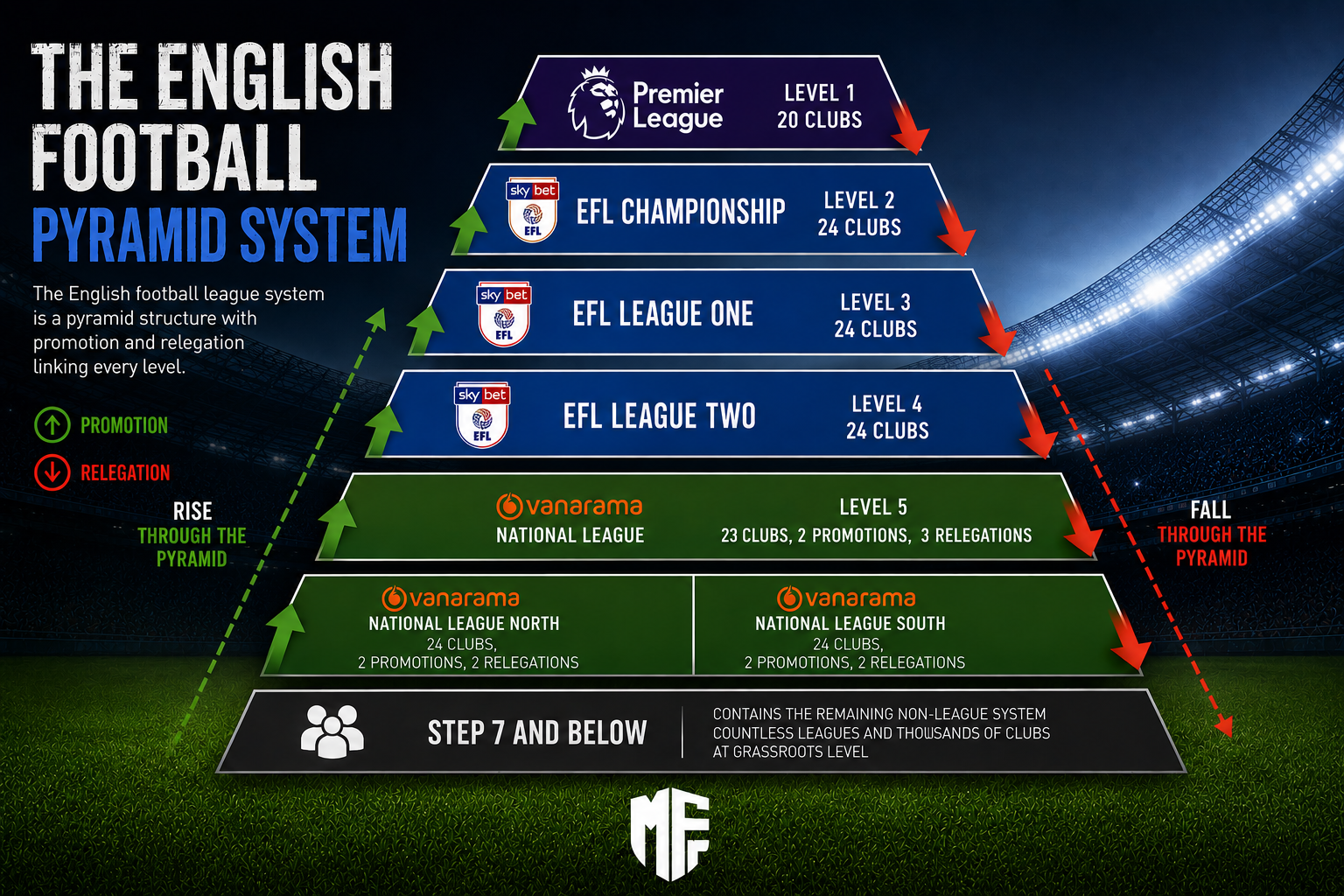

| Tier | League | Clubs | Status |
|---|---|---|---|
| 1 | Premier League | 20 | Professional |
| 2 | EFL Championship | 24 | Professional |
| 3 | EFL League One | 24 | Professional |
| 4 | EFL League Two | 24 | Professional |
| 5 | National League | 24 | Semi-professional |
| 6 | National League North / South | ~22 each | Semi-professional |
| 7 | Northern Premier / Southern / Isthmian | ~22 each | Semi-pro / amateur |
| 8 | Regional divisions of Tier 7 leagues | ~20 each | Semi-pro / amateur |
| 9-11 | Regional and county leagues | Varies | Amateur |
English football has at least 11 tiers, linked by promotion and relegation. The top five are nationwide professional or semi-professional leagues; from Tier 6 down they split into regional divisions.
- Premier League: 20 clubs (Tier 1)
- EFL Championship: 24 clubs (Tier 2)
- EFL League One: 24 clubs (Tier 3)
- EFL League Two: 24 clubs (Tier 4)
- National League: top tier of non-league football (Tier 5)
- National League North and National League South (Tier 6)
- Northern Premier, Southern League and Isthmian League (Tier 7)
- Regional divisions of those three leagues (Tier 8)
- Tiers 9-11: increasingly local regional leagues
English Football League Pyramid System
The English football pyramid is the hierarchical system of leagues that links every level of the game in England, from the global spectacle of the Premier League down to local amateur divisions. Bound together by promotion and relegation, it allows any club, in theory, to climb from the grassroots all the way to the top flight.
The system spans at least 11 levels: Tier 1 is the Premier League, Tier 2 the EFL Championship, Tier 3 League One and Tier 4 League Two, with the National League at Tier 5 marking the top of non-league football. Below that, Tiers 6 to 11 fan out into an increasingly regional network of divisions. In total the structure covers 19 leagues from Tier 1 to Tier 8 and around 83 leagues across Tiers 9 to 11.
Current English Football Pyramid System of England’s Football Leagues
| 1st Level |  | ||||||||||||||
| Premier League | |||||||||||||||
| 20 clubs, 3 relegations | |||||||||||||||
| 2nd Level |  | ||||||||||||||
| EFL Championship | |||||||||||||||
| "The League" | 24 clubs, 3 promotions, 3 relegations | ||||||||||||||
| 3rd Level |  | ||||||||||||||
| EFL League One | |||||||||||||||
| 24 clubs, 3 promotions, 4 relegations | |||||||||||||||
| 4th Level |  | ||||||||||||||
| EFL League Two | |||||||||||||||
| 24 clubs, 4 promotions, 2 relegations | |||||||||||||||
| 5th Level |  | ||||||||||||||
| "Non-League Football" | National League | ||||||||||||||
| 5th Level and Lower | 23 clubs, 2 promotions, 3 relegations | ||||||||||||||
| 6th Level |  |  | 6th Level | ||||||||||||
| National League North | National League South | ||||||||||||||
| 22 clubs, 2 p, 2 r | 21 clubs, 2 p, 1 r | ||||||||||||||
| 7th Level | 7th Level | 7th Level | 7th Level | ||||||||||||
| Northern Premier League | Southern League | Southern League | Isthmian League | ||||||||||||
| Premier Division | Central Division | South Division | Premier Division | ||||||||||||
| 22 clubs, 2 p, 4 r | 21 clubs, 2 p, 3 r | 22 clubs, 2 p, 4 r | 22 clubs, 2 p, 4 r | ||||||||||||
| 8th Level | 8th Level | 8th Level | 8th Level | 8th Level | 8th Level | 8th Level | 8th Level | ||||||||
| Northern PL | Northern PL | Northern PL | Southern League | Southern League | Isthmian League | Isthmian League | Isthmian League | ||||||||
| Division One North East | Division One Midlands | Division One West | Division One Central | Division One South | Division One South Central | Division One North | Division One South East | ||||||||
| 19 Clubs | 20 Clubs | 20 Clubs | 20 Clubs | 19 Clubs | 19 Clubs | 20 Clubs | 20 Clubs | ||||||||
| 2 p, 1-3 r | 2 p, 2-4 r | 2 p, 2-4 r | 2 p, 2-4 r | 2 p, 1-3 r | 2 p, 1-3 r | 2 p, 2-4 r | 2 p, 2-4 r | ||||||||
| 9th Level | ||
|---|---|---|
| Combined Counties League Premier Division North – 18 clubs — 1–2p, 2r | Northern League Division One – 20 clubs — 1–2p, 2r | |
| Combined Counties League Premier Division South – 20 clubs — 1–2p, 2r | Southern Combination League Premier Division – 20 clubs — 1–2p, 2r | |
| Eastern Counties League Premier Division – 20 clubs — 1–2p, 2r | Southern Counties East League Premier Division – 20 clubs — 1–2p, 2r | |
| Essex Senior League – 21 clubs — 1–2p, 2r | Spartan South Midlands League Premier Division – 20 clubs — 1–2p, 2r | |
| Hellenic League Premier Division – 20 clubs — 1–2p, 2r | United Counties League Premier Division North – 18 clubs — 1–2p, 2r | |
| Midland League Premier Division – 19 clubs — 1–2p, 2r | United Counties League Premier Division South – 21 clubs – 1-2p, 2r | |
| North West Counties League Premier Division – 21 clubs — 1–2p, 2r | Wessex League Premier Division – 21 clubs – 1–2p, 2r | |
| Northern Counties East League Premier Division – 20 clubs — 1–2p, 2r | Western League Premier Division – 19 clubs — 1–2p, 2r | |
| 10th Level | ||
| Combined Counties League Division One – 21 clubs – 2p, 0–3r | Northern League Division Two – 20 clubs – 2p, 0–3r | |
| Eastern Counties League Division One North – 16 clubs – 2p, 0–3r | South West Peninsula League Premier Division East – 20 clubs – 1p, 0–3r | |
| Eastern Counties League Division One South – 20 clubs – 2p, 0–3r | South West Peninsula League Premier Division West – 20 clubs – 1p, 0–3r | |
| Hellenic League Division One – 20 clubs – 2p, 0–3r | Southern Combination League Division One – 18 clubs – 2p, 0–3r | |
| Midland League Division One – 19 clubs – 2p, 0–3r | Southern Counties East League Division One – 20 clubs – 2p, 0–3r | |
| North West Counties League Division One North – 19 clubs – 2p, 0–3r | Spartan South Midlands League Division One – 20 clubs – 2p, 0–3r | |
| North West Counties League Division One South – 20 clubs – 2p, 0–3r | United Counties League Division One – 23 clubs – 2p, 0–3r | |
| Northern Counties East League Division One – 21 clubs – 2p, 0–3r | Wessex League Division One – 20 clubs – 2p, 0–3r | |
| Western League Division One – 21 clubs – 2p, 0–3r | ||
| 11th Level | ||
| Anglian Combination Premier Division – 16 clubs | North Riding League Premier Division – 16 clubs | |
| Bedfordshire County League Premier Division – 16 clubs | Northamptonshire Combination League Premier Division – 16 clubs | |
| Cambridgeshire County League Premier Division – 16 clubs | Northern Alliance Premier Division – 16 clubs | |
| Central Midlands League Premier Division North – 14 clubs | Nottinghamshire Senior League Senior Division – 18 clubs | |
| Central Midlands League Premier Division South – 14 clubs | Oxfordshire Senior League Premier Division – 16 clubs | |
| Cheshire League Premier Division – 16 clubs | Peterborough & District League Premier Division – 16 clubs | |
| Devon Football League North & East Division – 16 clubs | Sheffield & Hallamshire County Senior League Premier Division – 15 clubs | |
| Devon Football League South & West Division – 16 clubs | Shropshire County Football League – 14 clubs | |
| Dorset Premier League – 16 clubs | Somerset County League Premier Division – 18 clubs | |
| Essex & Suffolk Border League Premier Division – 16 clubs | Southern Combination League Division Two – 16 clubs | |
| Essex Alliance League Senior Division – 14 clubs | Spartan South Midlands League Division Two – 16 clubs | |
| Essex Olympian League Premier Division – 16 clubs | St Piran League East Division – 16 clubs | |
| Gloucestershire County League – 16 clubs | St Piran League West Division – 16 clubs | |
| Hampshire Premier League Senior Division – 16 clubs | Staffordshire County Senior League Premier Division – 16 clubs | |
| Herefordshire FA County League Premier Division – 15 clubs | Suffolk & Ipswich League Senior Division – 16 clubs | |
| Hertfordshire Senior County League Premier Division – 16 clubs | Surrey Elite Intermediate League – 16 clubs | |
| Humber Premier League Premier Division – 16 clubs | Thames Valley Premier League Premier Division – 16 clubs | |
| Kent County League Premier Division – 16 clubs | Wearside League Division One – 16 clubs | |
| Leicestershire Senior League Premier Division – 16 clubs | West Cheshire League Division One – 16 clubs | |
| Lincolnshire League – 14 clubs | West Lancashire League Premier Division – 16 clubs | |
| Liverpool Premier League Premier Division – 16 clubs | West Midlands (Regional) League Division One – 16 clubs | |
| Manchester League Premier Division – 16 clubs | West Yorkshire League Premier Division – 16 clubs | |
| Mid-Sussex League Premier Division – 14 clubs | Wiltshire Senior League Premier Division – 16 clubs | |
| Middlesex County League Premier Division – 17 clubs | York League Premier Division – 16 clubs | |
| Midland League Division Two – 16 clubs | Yorkshire Amateur League Supreme Division – 15 clubs |
English Football Pyramid Explained
The English football league system, also known as the English football pyramid, is a hierarchical structure of professional and semi-professional leagues in England, bound together by promotion, relegation and two national cup competitions.
The 92 League Clubs
The 92 clubs in the top four tiers, the Premier League, Championship, League One and League Two, all compete in the Football League Cup and the FA Cup.
The top five tiers (the Premier League, Championship, League One, League Two and the National League, the top division of non-league football) each contain a single division and are nationwide in scope.
The National League System
Below the EFL, the National League System, run by The FA, stretches from the 5th to the 11th level. In 2022-23 it featured 640 teams across 57 leagues and 84 divisions, all eligible for the FA Cup and acting as a feeder system through to the EFL.
The number of clubs in each league can change from season to season as clubs are promoted, relegated, merge or fold, so it is worth checking the current line-ups before following fixtures or looking at live betting on English soccer.
How Promotion and Relegation Work
The pyramid is designed to let clubs climb as they become more successful and grow their fan base, revenue and infrastructure. Clubs that perform poorly are relegated, creating a constant turnover of teams and a competitive system that is unique to English football.
The Premier League
At the top of the pyramid is the Premier League, which consists of 20 clubs and is widely regarded as one of the best football leagues in the world. It is one of the most-watched sports leagues on the planet and attracts many of the world’s best players.
The English Football League (EFL)
Beneath the Premier League is the English Football League (EFL), made up of three divisions: the Championship, League One and League Two.
The Championship is the second tier and is widely regarded as one of the toughest and most competitive leagues in the world. It has 24 teams and is known for its intense promotion and relegation battles.
League One and League Two are the third and fourth tiers, with 24 teams each. They are mainly made up of smaller clubs and often act as a stepping stone for players and managers looking to progress to higher levels.
Non-League Football
Beneath the EFL sit the semi-professional leagues, including the National League, National League North and National League South. These leagues feature a mix of semi-professional and amateur clubs and give young players and clubs a platform to develop and gain valuable experience.
Grassroots Football
At the base of the pyramid are the grassroots leagues, made up of local clubs that are often run by volunteers. They give people of all ages and abilities the chance to play football and enjoy the sport at a community level.
The English football pyramid has produced some of the world’s best players and most competitive leagues. It allows clubs to progress as they grow while giving grassroots football room to flourish, so whether you follow a Premier League giant or a local amateur side, there is something for everyone.
Women’s Football Pyramid in England
England’s women’s football pyramid mirrors the structure of the men’s game, connecting professional and amateur leagues through promotion and relegation. Since the formation of the Women’s Super League in 2011 and its move to a fully professional model in 2018, the women’s pyramid has grown significantly. With the Lionesses’ Euro 2022 win sparking a surge in attendances and participation, it continues to expand rapidly.
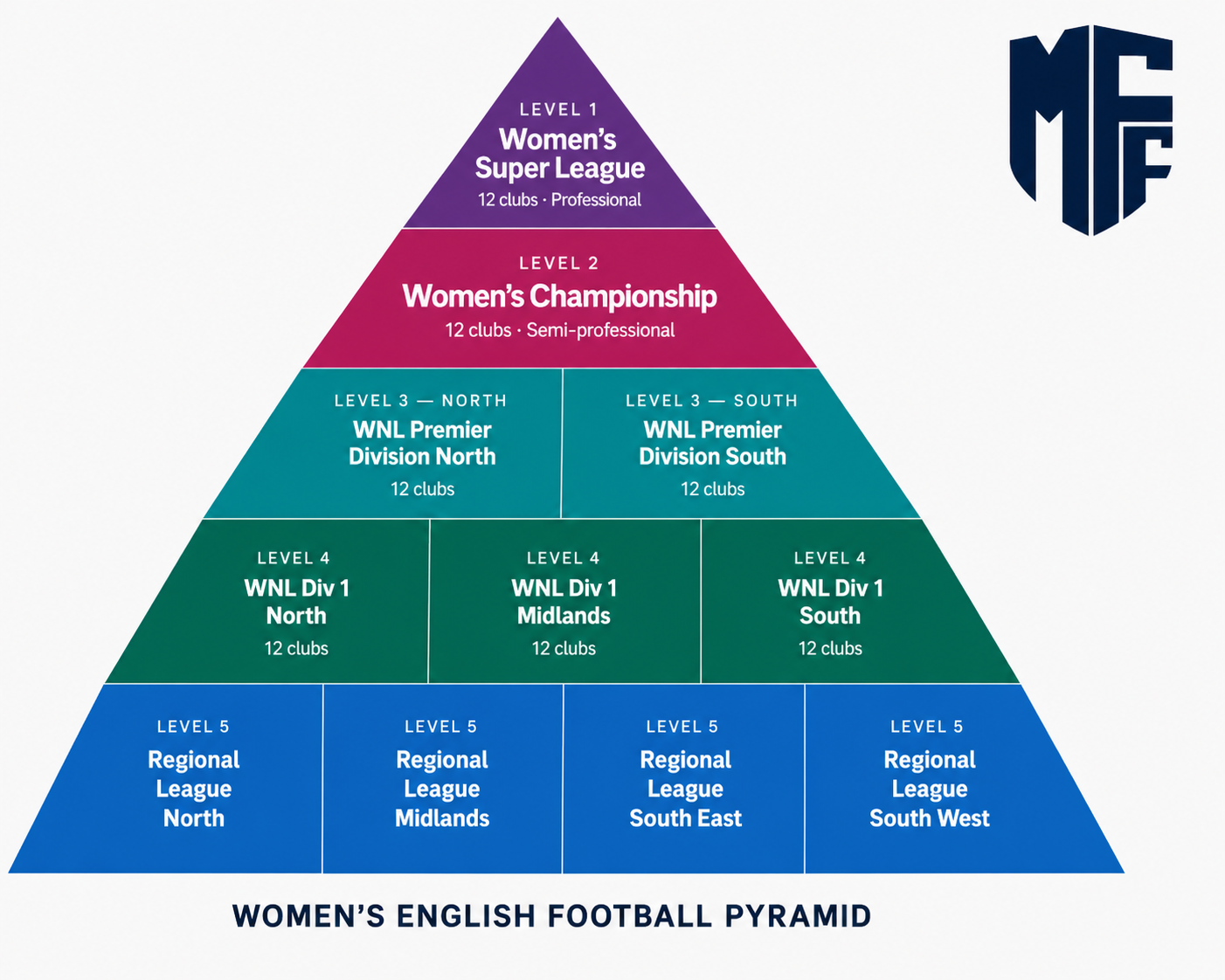
Level 1: Barclays Women’s Super League (WSL)
The Women’s Super League is the top tier of women’s football in England. It consists of 12 clubs competing in a fully professional league. The WSL champion qualifies for the UEFA Women’s Champions League. The bottom club is relegated to the Women’s Championship, subject to meeting the FA’s licensing criteria. Current WSL clubs include Chelsea, Arsenal, Manchester City, Manchester United and Aston Villa, among others.
Level 2: Women’s Championship
The Women’s Championship is the second tier, currently featuring 12 clubs. The league winner earns promotion to the WSL, provided they satisfy the FA’s licensing requirements covering stadium capacity, facilities and financial sustainability. The bottom club is relegated to the Women’s National League (Level 3). The Championship is the primary pathway for ambitious clubs looking to reach the professional game.
Level 3: Women’s National League Premier Divisions (North and South)
At Level 3, the pyramid splits into two regional divisions: the Women’s National League Premier Division North and the Women’s National League Premier Division South. Each division winner enters a playoff against the other to determine which club earns promotion to the Women’s Championship. The bottom teams in each division are relegated to the Division One leagues at Level 4.
Level 4: Women’s National League Division One
Level 4 splits further into four regional divisions: Division One North, Division One Midlands, Division One South East and Division One South West. Winners of each division are promoted to Level 3, while bottom clubs drop into Level 5 regional leagues.
Levels 5 and Below: Regional Leagues
Below Level 4, the women’s pyramid continues through a network of regional leagues that vary by county and area. These lower tiers are predominantly semi-professional and amateur, providing the grassroots pathway through which players and clubs can progress towards the professional game. The FA has continued to restructure these tiers to create clearer promotion pathways throughout the system.
Key Differences Between the Men’s and Women’s Pyramids
While the structures are similar in principle, there are important practical differences. In the women’s game, promotion is not automatic: clubs must meet FA licensing criteria covering facilities, finances and safeguarding to move up, so a club can finish first but still miss out if it fails the licence assessment.
The women’s pyramid is also smaller at the top, with 12 clubs in the WSL compared with 20 in the Premier League, and the regional split happens earlier, at Level 3 rather than Level 6.
English Football Pyramid FAQs
Here’s a handy list of FAQs to help you navigate the English football pyramid system, covering the most common questions about how the English league structure works.
What is the English Football Pyramid System?
It’s a hierarchical league structure in English football that links professional, semi-professional and amateur leagues through promotion and relegation, allowing clubs to move up or down based on performance.
How many levels does the pyramid include?
The system stretches from the Premier League at the top (Level 1) down through many regional leagues, reaching at least the 11th level.
Which league is at the top of the pyramid?
The Premier League, with 20 clubs, sits at the top and is the highest level of English football.
How does promotion from the Championship to the Premier League work?
Three Championship clubs are promoted to the Premier League each season: the top two automatically and one more via the playoffs.
What leagues make up the English Football League (EFL)?
The EFL comprises the Championship (Level 2), League One (Level 3) and League Two (Level 4).
What is “Non-League Football”?
Leagues below League Two (Level 5 and lower) are termed non-league football, starting with the National League and spreading into many regional divisions.
How many clubs are in League One and League Two?
League One and League Two have 24 clubs each, with promotion and relegation places every season.
What happens to teams relegated from League Two?
Relegated League Two teams drop into the National League (Level 5), the top level of non-league football.
How are the lower regional divisions organised?
From Level 6 downwards, leagues are geographical, such as National League North and South and the regional premier divisions below them, to reduce travel and group clubs locally.
Can a small amateur club theoretically reach the Premier League?
Yes. Through consistent promotion over many seasons, even a club from the lowest regional division could climb to the very top of the pyramid.
Are there different rules for promotion at regional levels?
Yes. At some lower levels, promotion and relegation can vary by league size, geography and playoff structures.
Do all clubs in the pyramid compete in the same cup competitions?
Clubs from many levels can enter national cups like the FA Cup, though entry rounds and eligibility differ by tier and league status. That route produces famous upsets: on 10 January 2026, non-league Macclesfield FC beat FA Cup holders Crystal Palace 2-1. It was the first time a non-league side had knocked out the holders since 1908-09, when the giant-killers were, ironically, a non-league Crystal Palace, who beat Wolverhampton Wanderers.