
The 2026 FIFA World Cup is set to be the biggest tournament in football history, and fans across the globe are already eager to understand how the 2026 World Cup draw will shape the road to glory. With 48 nations competing for the first time, the World Cup 2026 groups will look very different from previous editions, creating more drama, more rivalries and even the possibility of a terrifying group of death 2026 scenario.
As excitement builds, supporters are also curious about the role of the World Cup 2026 pots, the latest World Cup seeding 2026 system and, most importantly, how does World Cup draw work in this expanded format. In this guide, we break down the full process behind the tournament draw, explain how teams are placed into groups and explore what fans can expect ahead of the biggest World Cup ever staged.
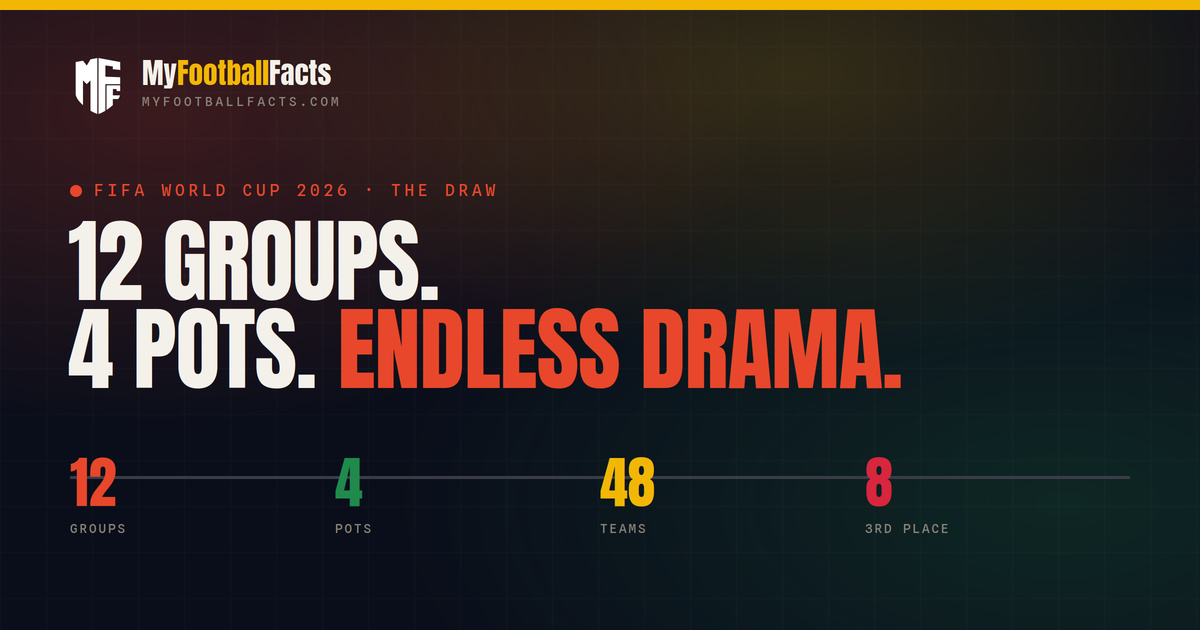
2026 World Cup Groups and Draw Explained — 12 Groups.
4 Pots.
Endless Drama.
With 48 teams in 12 groups, the 2026 draw is the most complex ever. Here is how the pots, seeding and the dreaded “group of death” actually work.
The 2026 World Cup Groups & Draw, Explained
With 48 teams split into 12 groups of four, the 2026 World Cup draw is more complex than ever. Understanding how the pots work — and how the “group of death” emerges — is the key to reading the tournament before a ball is kicked.
How The Draw Works · 4 Pots
Fig. 01 — Seeding Structure
How the pots are built
Teams are sorted into four pots of 12 based largely on the FIFA World Ranking, with the host nations placed among the top seeds in Pot 1. The draw then assigns one team from each pot into every group, so each group contains a spread of seeding tiers — one strong seed and three teams of descending strength.
The rules that shape the groups
- Confederation separation — teams from the same confederation are generally kept apart in the group stage (with limited exceptions for Europe, which has the most teams).
- Host positioning — the host nations are pre-assigned to specific groups and positions to anchor the schedule.
- Geographic balance — the draw also considers travel and venue distribution across the three regional clusters.
What is a “group of death”?
It is the group where the draw clusters several strong teams together, so that a genuine contender is at risk of early elimination. With 48 teams, the seeding is designed to spread quality — but the unpredictability of Pots 2 and 3 means at least one group always ends up brutally tough. Spotting it is half the fun of draw day.
How teams advance from the groups
The top two from each of the 12 groups qualify automatically — that is 24 teams. They are joined by the eight best third-placed teams, ranked across all groups, to complete the 32-team knockout field. This means finishing third is no longer certain elimination, adding a layer of cross-group tension right up to the final round of group matches.
More on the 2026 World Cup
- How to Buy FIFA World Cup 2026 Tickets: The Complete Guide
- How to Buy Tickets to the 2026 FIFA World Cup
- 2026 World Cup Host Cities: All 16 Stadiums, Capacities & Key Matches
Don’t Miss Out
Be There In 2026
The biggest World Cup in history is just around the corner. Secure your seats for the matches that matter before they sell out.