
The 2026 World Cup is the biggest the tournament has ever been, and the road to get there has been just as expanded. World Cup 2026 qualification stretched across every corner of the globe, with the 48 teams World Cup format opening up far more places than the 32-team editions fans grew up with. So who qualified for the 2026 World Cup, and how were all those spots divided up?
The answer comes down to geography. The World Cup 2026 confederations — UEFA, CAF, AFC, CONMEBOL, CONCACAF and OFC — were each handed a share of the 48 berths, with the larger and historically stronger regions receiving the biggest allocations. On top of those direct places, a set of World Cup 2026 play-offs, including an intercontinental mini-tournament, decided the final few qualifiers, giving nations that fell just short one last shot at the finals.
Below you’ll find the full picture of the 2026 World Cup qualified teams: a complete breakdown of how the 48 places are distributed across the six confederations, which nations have already booked their tickets, and how the remaining play-off berths work.

FIFA World Cup 2026 · The Format
2026 World Cup Format Explained — 48 Teams.
12 Groups.
One Cup.
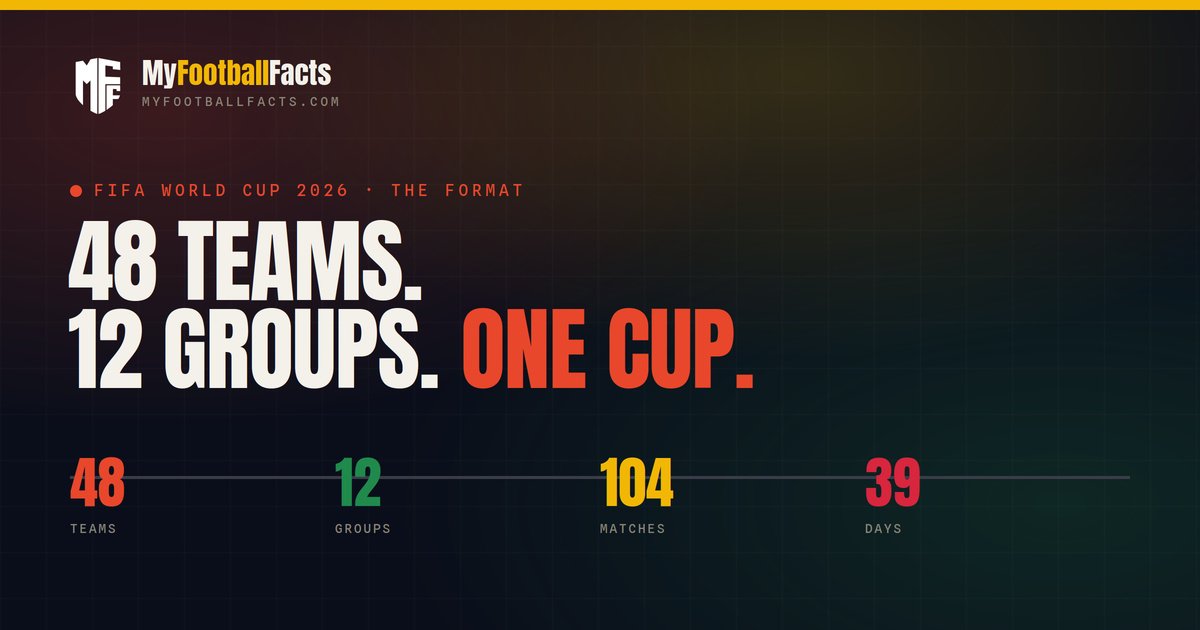
The 2026 World Cup is the biggest ever — 48 teams, 12 groups and 104 matches. Here is exactly how the new format works, from the group stage to the brand-new Round of 32.
The Big Change
The 48-Team World Cup, Explained
The 2026 FIFA World Cup is the first to feature 48 teams rather than the 32 that contested every tournament from 1998 to 2022. It is the largest expansion in the competition’s history, and it reshapes everything from the group stage to the number of games a champion must win.
For fans, players and host cities alike, the new structure means more nations, more matches, and a brand-new knockout round that never existed before. Here is how it all fits together.
48Teams12Groups of 432Reach Knockouts8Games to Win It
From 32 to 48: what actually changed
The old format used eight groups of four, with the top two from each advancing to a round of 16. The 2026 edition uses twelve groups of four. The top two in every group advance automatically, and they are joined by the eight best third-placed teams — giving 32 teams in the knockout phase.
That extra layer creates a new Round of 32, a stage the World Cup has never had before. A team that goes all the way will now play eight matches to lift the trophy, one more than under the old system.
The Road To The Final · Every Stage
Fig. 01 — Tournament Bracket Flow
GROUPS48 → 32R3232 → 16R1616 → 8QF8 → 4SF4 → 2FINAL2 → 1
8 MATCHES TO GLORY
GROUP STAGE → ROUND OF 32 → ROUND OF 16 → QUARTERS → SEMIS → FINAL
3 games each
How teams qualify from the group stage
- Top 2 of each group — 24 teams advance automatically.
- 8 best third-placed teams — ranked across all 12 groups by points, then goal difference, then goals scored.
- Total: 32 teams progress into the Round of 32 knockout phase.
The “best third-placed teams” rule is the trickiest wrinkle. Finishing third in your group is no longer automatic elimination — but it is a nervous wait, because only two-thirds of third-place finishers survive.
Why FIFA expanded the tournament
The expansion opens the World Cup to more nations than ever, particularly from confederations that historically received few places. It also means more matches to broadcast and more host-city fixtures — a commercial and sporting boost. Critics argue it dilutes quality in the early rounds, but supporters point to the drama of more nations getting their moment on the world stage.
What it means for the eventual winner
Under the previous format, a champion played seven matches. In 2026 it is eight, thanks to the added Round of 32. That is more minutes, more squad rotation, and a greater premium on depth — one reason squad sizes and fitness management will be talking points all summer.
More on the 2026 World Cup