Football tactics do not evolve by themselves. Behind every major tactical revolution are managers willing to question established ideas, experiment with new systems and persuade players to see the game differently.
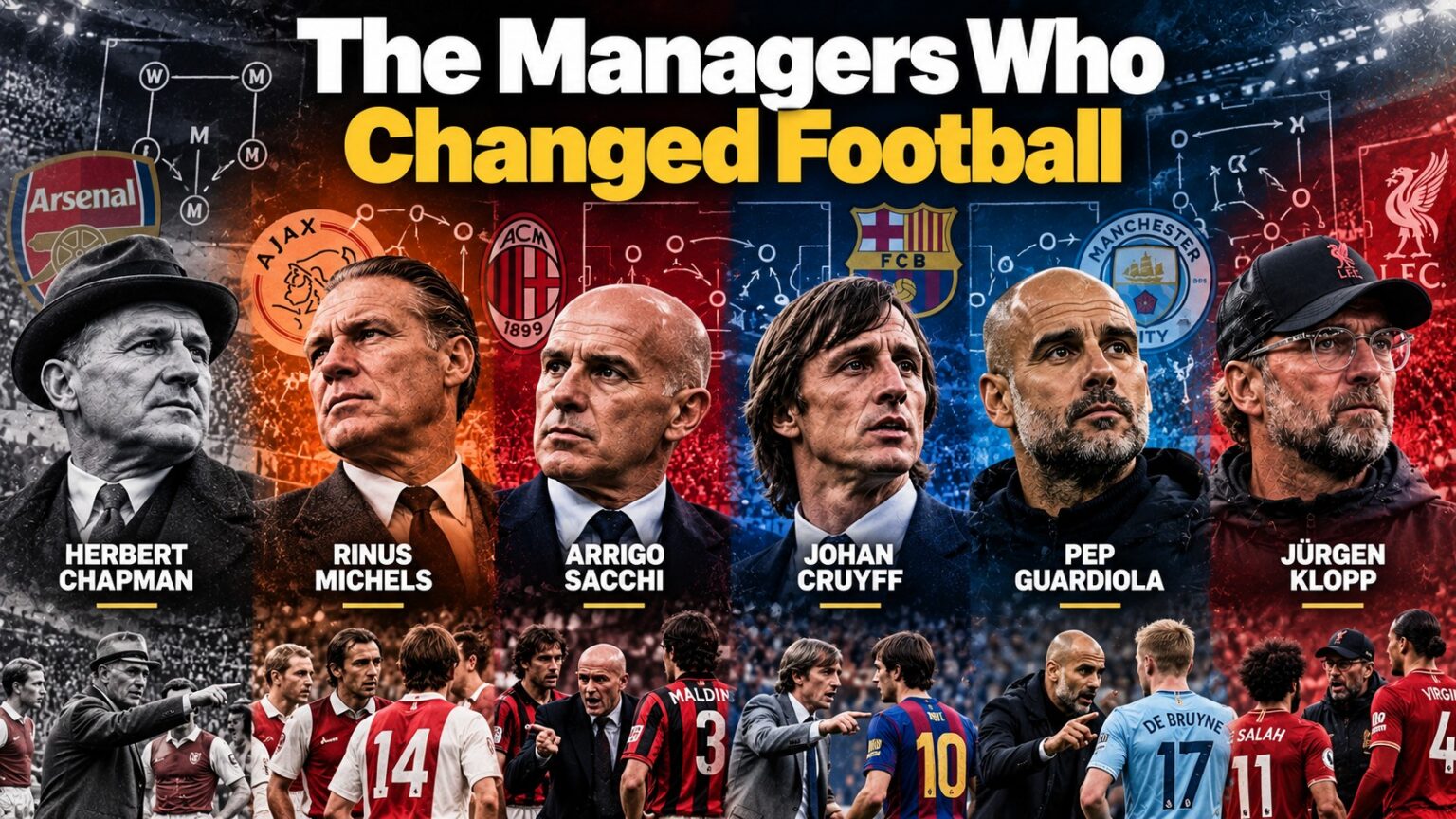
From the WM formation of Herbert Chapman to the Total Football of Rinus Michels, the pressing revolution of Arrigo Sacchi and the positional play of Johan Cruyff and Pep Guardiola, certain managers have changed not only how their teams played, but how football itself was understood.
Some changed formations. Others changed training methods. Some changed the way players occupied space, while others transformed the relationship between possession, pressing and defending.
This is the story of the managers whose ideas helped drive the evolution of football.
Herbert Chapman: Football Finds Its Shape
Few managers were more influential in the transformation of early English football than Herbert Chapman.
Chapman’s importance was closely connected to the major offside law change of 1925. With attackers suddenly able to exploit more space behind defensive lines, the traditional 2-3-5 Pyramid needed to evolve.
At Arsenal, Chapman helped develop the tactical structure that became known as the WM formation. The centre-half dropped deeper to create a third defender, while the overall team became more balanced between defence and attack.
Chapman’s Arsenal went on to win the FA Cup in 1930 and the First Division title in 1930-31, demonstrating how tactical innovation could translate into sustained success.
But Chapman’s influence extended beyond formations. He introduced ideas around training, preparation, player recruitment and tactical organisation that helped move football management towards a more modern profession.
Rinus Michels: Football Becomes Fluid
If Chapman helped give football a new defensive structure, Dutch manager Rinus Michels helped make the game far more fluid.
Michels developed his ideas at Ajax during the 1960s and became the central managerial figure associated with Total Football.
His teams were built around movement, positional interchange, pressing and technical ability. Players were expected to understand not only their own position but the spaces occupied by their teammates.
Ajax won the European Cup three times in succession from 1971 to 1973, while Michels later took his ideas to the Netherlands national team.
The Dutch reached the 1974 World Cup final, producing one of the tournament’s most influential tactical performances even though West Germany eventually won the final.
Michels had helped establish a principle that would become increasingly important in modern football: a player’s position could change, provided the team’s overall structure remained intact.
Arrigo Sacchi: The Defence That Attacked
By the late 1980s, Italian football had a long-established reputation for defensive organisation. Arrigo Sacchi challenged many of the assumptions surrounding that tradition.
When Sacchi arrived at AC Milan, he built a team that defended aggressively rather than simply retreating towards its own penalty area.
His Milan side used a high defensive line, pressing and coordinated movement between defenders and midfielders. The objective was to reduce the amount of space available to the opposition.
Instead of thinking about defending as a collection of individual battles, Sacchi treated the team as a single defensive unit.
The back four moved together. The midfield moved with them. The distance between the lines was carefully controlled.
The result was a Milan side capable of defending high up the pitch while also creating opportunities through rapid attacking transitions.
Sacchi’s Milan and the European Cup
Sacchi’s Milan won the European Cup in 1989 and successfully defended it in 1990.
The team featured extraordinary players including Franco Baresi, Paolo Maldini, Mauro Tassotti, Alessandro Costacurta, Ruud Gullit, Frank Rijkaard and Marco van Basten.
Yet the tactical structure was arguably just as important as the individual talent.
Sacchi demonstrated that pressing could be used as a defensive weapon and that a team did not need to surrender possession or territory simply because it was defending.
His ideas would influence coaches across Europe for decades. UEFA has described Sacchi’s Milan as a tactical revolution that changed the philosophy, training methods and intensity of Italian football.
Johan Cruyff: The Manager Who Changed Barcelona
Few football figures had a greater influence on the modern game than Johan Cruyff.
Cruyff had already changed football as a player. As manager of Barcelona, he helped establish a footballing philosophy based on possession, attacking movement, technical ability and positional understanding.
Appointed Barcelona manager in 1988, Cruyff built the team that became known as the Dream Team.
Barcelona won four consecutive Spanish league titles between 1991 and 1994 and lifted the club’s first European Cup at Wembley in 1992.
But Cruyff’s greatest influence was philosophical. He encouraged players to think about the game rather than simply follow rigid instructions.
The principles he established at Barcelona would influence the club’s academy, its first team and a generation of coaches who came through the system.
Barcelona itself describes Cruyff’s coaching philosophy as a revolution based around possession, attacking football, creativity and confidence in young players.
From Cruyff to Guardiola
One of the most remarkable aspects of Cruyff’s legacy is that his influence did not end when he left the Barcelona dugout.
One of the players who absorbed his ideas was Pep Guardiola.
Guardiola had been a central midfielder in Cruyff’s Barcelona team. Years later, he returned to the club as manager and took many of those principles into an entirely new era.
When Guardiola took charge in 2008, Barcelona already possessed a strong footballing identity. He refined it through positional play, pressing, possession and carefully structured movement.
The result was one of the most successful and influential teams of the modern era.
Pep Guardiola: Football as Positional Play
Guardiola’s tactical philosophy is often associated with positional play.
The principle is that players should occupy spaces that give the team useful passing options while stretching the opposition’s defensive structure.
Rather than asking every player to remain in a fixed position, Guardiola’s teams use carefully coordinated movements to create numerical and positional advantages.
Full-backs can move into midfield. Midfielders can rotate positions. Forwards can drop between the lines. Centre-backs can carry the ball forward.
The formation on the team sheet therefore becomes only part of the story.
The Barcelona Six-Trophy Year
Guardiola’s first Barcelona season was extraordinary.
In 2008-09, Barcelona won La Liga, the Copa del Rey and the Champions League. The following season they added the Spanish Super Cup, UEFA Super Cup and FIFA Club World Cup, completing a unique run of six trophies in 2009.
Barcelona’s official history records the 2009 sextuple as the first time a club had won all six major trophies available across a calendar year.
Guardiola’s Barcelona also demonstrated how possession and pressing could work together.
Possession controlled the ball. Positioning controlled the spaces. Pressing attempted to win the ball back immediately when possession was lost.
Jürgen Klopp: The Counter-Pressing Revolution
While Guardiola’s teams became associated with positional control, Jürgen Klopp developed another highly influential approach to modern football.
Klopp’s teams are strongly associated with Gegenpressing, or counter-pressing: the attempt to win the ball back immediately after losing possession.
The principle turns the moment of losing possession into an attacking opportunity.
If the opposition has just won the ball, its players may be spread across the pitch, with passing options still developing. A coordinated press can exploit that temporary lack of organisation.
Klopp developed this approach at Borussia Dortmund before bringing it to the Premier League with Liverpool.
His Dortmund side won consecutive Bundesliga titles in 2010-11 and 2011-12, while Liverpool later won the Champions League in 2019 and the Premier League in 2019-20.
Different Managers, Similar Questions
Chapman, Michels, Sacchi, Cruyff, Guardiola and Klopp developed very different tactical systems.
Yet they were all attempting to answer similar questions.
- How should a team use space?
- Where should players position themselves?
- How should a team defend?
- How quickly should possession be recovered?
- How can a team create space for its best players?
- How should the team change shape when possession changes?
The answers changed over time, but the questions remained remarkably consistent.
The Managers Who Changed Football
| Manager | Era | Key Tactical Contribution |
|---|---|---|
| Herbert Chapman | 1920s-1930s | WM formation, defensive structure and modern tactical organisation |
| Rinus Michels | 1960s-1970s | Total Football, positional interchange and pressing |
| Arrigo Sacchi | 1980s-1990s | High defensive line, pressing and compact team structure |
| Johan Cruyff | 1980s-1990s | Possession, positional play and Barcelona’s footballing philosophy |
| Pep Guardiola | 2000s-present | Positional play, structured possession and modern pressing |
| Jürgen Klopp | 2000s-present | Gegenpressing, transitions and aggressive pressing |
From the Manager’s Chalkboard to the Modern Training Ground
The role of the football manager has changed dramatically alongside tactics.
Early managers could influence formations and team selection, but the modern coach has far more information available. Training sessions can be designed around specific phases of play, opposition weaknesses and pressing patterns.
Video analysis, tracking data and detailed performance statistics have made it possible to study football at a level that earlier generations could never have imagined.
Yet the basic challenge remains the same: find a way to make eleven players operate more effectively as a team than the opposition.
Football’s Tactical Evolution Never Stops
The history of football formations is therefore not a story with a final destination.
The 2-3-5 evolved into the WM. The WM helped lead towards new defensive structures. Catenaccio and Total Football offered radically different answers to the problem of controlling space. Sacchi brought pressing and compactness to another level. Cruyff and Guardiola developed possession and positional play, while Klopp demonstrated the attacking possibilities of counter-pressing.
Modern football now combines ideas from all of these traditions.
A team can build possession with a positional structure, defend with a compact block, press high after losing the ball and counter-attack within seconds.
The formations may continue to change, but the fundamental battle remains the same: space, time and control.
Football Managers FAQs
Who changed football tactics the most?
Football’s tactical development has been influenced by many managers across different eras. Herbert Chapman, Rinus Michels, Arrigo Sacchi, Johan Cruyff, Pep Guardiola and Jürgen Klopp are among the managers whose ideas had major influence on formations, pressing, possession and positional play.
Who invented the WM formation?
The WM formation is most closely associated with Herbert Chapman and Arsenal, although its development was a collective tactical process involving players and coaches responding to the 1925 offside law.
Who invented Total Football?
Total Football was not the invention of a single individual. Rinus Michels became its most famous managerial architect, particularly through his work with Ajax and the Netherlands, while players including Johan Cruyff were central to putting its principles into practice.
What did Arrigo Sacchi change?
Sacchi helped popularise a highly coordinated pressing and defensive system based on a compact team shape, a high defensive line and collective movement. His AC Milan teams of the late 1980s and early 1990s became a major influence on modern pressing football.
What did Johan Cruyff change about football?
As a manager, Cruyff helped establish a possession-based, attacking football philosophy at Barcelona built around technical ability, movement, positional understanding and the development of young players.
How did Pep Guardiola change football?
Guardiola developed and popularised a highly structured form of positional play that combines possession, movement, pressing and spatial control. His Barcelona teams helped make these ideas central to the modern tactical conversation.
The Evolution of Football
Football’s history is a continuous conversation between managers, players, rules and ideas.
The Pyramid gave way to the WM. The WM evolved into new formations. Catenaccio and Total Football offered contrasting solutions to the problems of space and defence. Pressing changed how teams defended, while Tiki-Taka and positional play transformed how possession could be used as a tactical weapon.
And behind each revolution were managers prepared to challenge what had come before.
That is the real story of The Evolution of Football: the game never stops changing.