

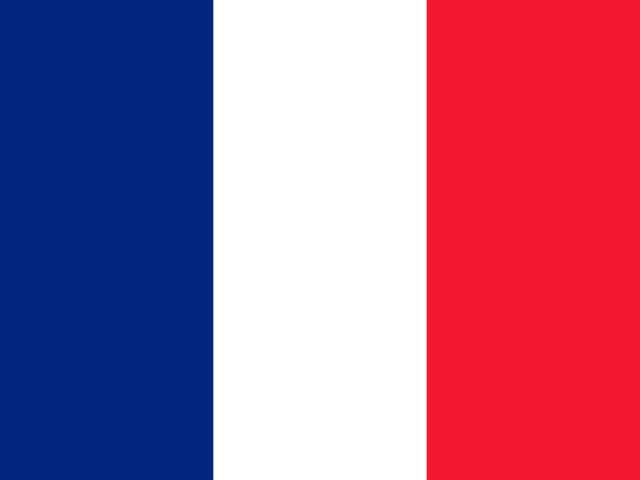
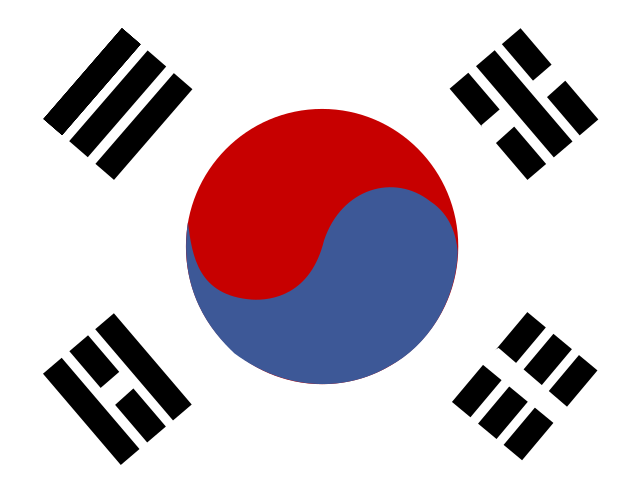
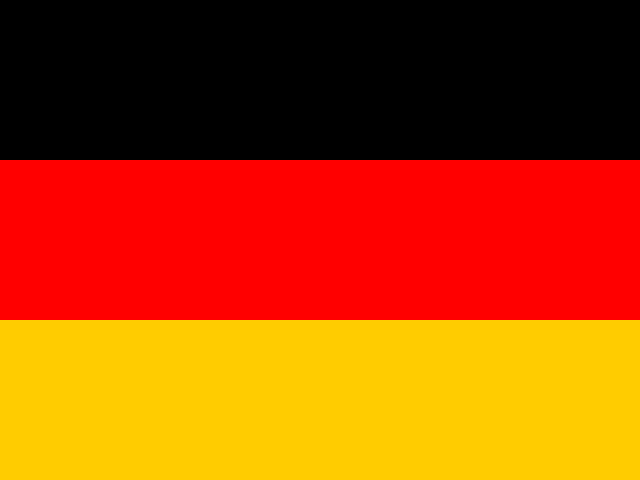


Korea / Japan 31 May – 30 June 2002 The 17th FIFA World Cup
2002
The World Cup that broke the script
Football went east for the first time — and almost nothing happened the way it was supposed to. Holders sent home, an Asian co-host in the last four, and a striker reborn from the wreckage of his own body.
A long read · myfootballfacts.com
The 2002 FIFA World Cup, staged across South Korea and Japan, was the moment football’s biggest tournament left its comfort zone. For seventy years the World Cup had only ever lived in two places: Europe and the Americas. In the summer of 2002 it boarded a plane and flew somewhere else entirely. Hosted jointly by two nations, it was the first World Cup staged in Asia, the first held outside the sport’s traditional heartlands, and the first ever shared by two countries.
It was also, by almost any measure, the strangest tournament in living memory — a month of toppled favourites, disputed refereeing, monsoon rain and noise that no one who was there has ever forgotten. By the time Brazil lifted the trophy in Yokohama, the old order of world football had been given a thorough, deafening shake. This is the story of Korea/Japan 2002.
A tournament goes east
Awarding the World Cup to two countries was, on paper, a fudge. South Korea and Japan had both bid to host alone, and the rivalry between them ran far deeper than football. Rather than crown one and humiliate the other, FIFA in 1996 did the pragmatic thing and handed it to both. Each nation built ten gleaming new stadiums; the matches were split down the middle, and the final was sent to Japan, at the International Stadium in Yokohama.
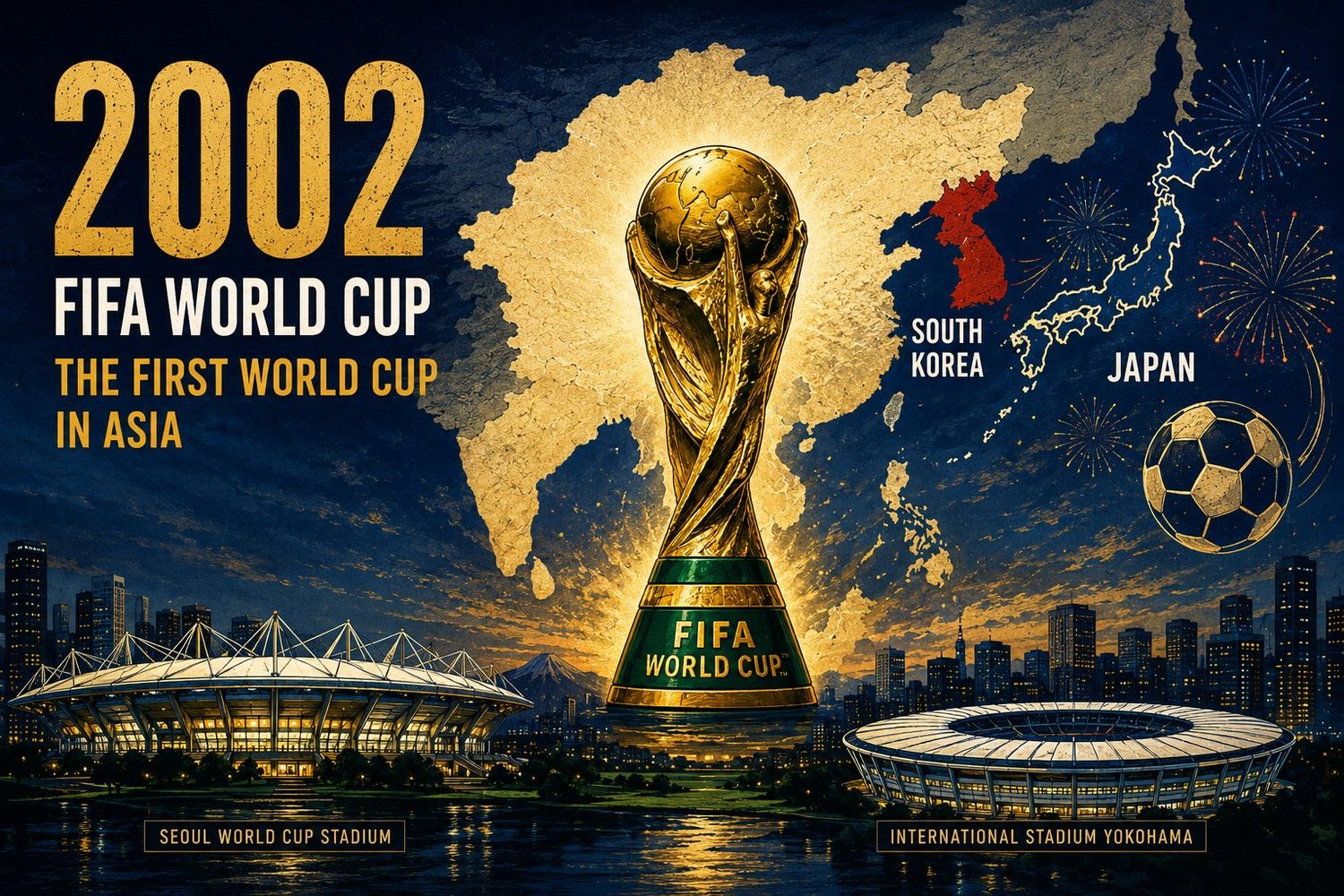
There were sceptics. The kick-off times were brutal for European television, the tournament fell in the monsoon season, and there was open doubt about whether Asian crowds would fill the grounds. Those doubts evaporated within days. Four nations — China, Ecuador, Senegal and Slovenia — arrived as debutants. Curiously, Tokyo, the Japanese capital, did not host a single match. This was a 32-team World Cup, the format that ran from 1998 to 2022 before the expanded 48-team format arrived; everything about it felt slightly off its axis, and that was before a ball had been kicked in anger.
32Teams
64Matches
20Stadiums in 2 nations
161Goals scored
SHOCK
The holders went home without scoring a single goal.
The opening night that set the tone
France arrived as world and European champions — the most complete team on the planet, with Zinedine Zidane orchestrating it. They opened the tournament in Seoul against Senegal, a debutant nation whose squad was drawn largely from the French league, some of them from its lower divisions. It was meant to be a coronation. Instead, Senegal won 1-0, and the World Cup announced exactly what kind of month this was going to be.
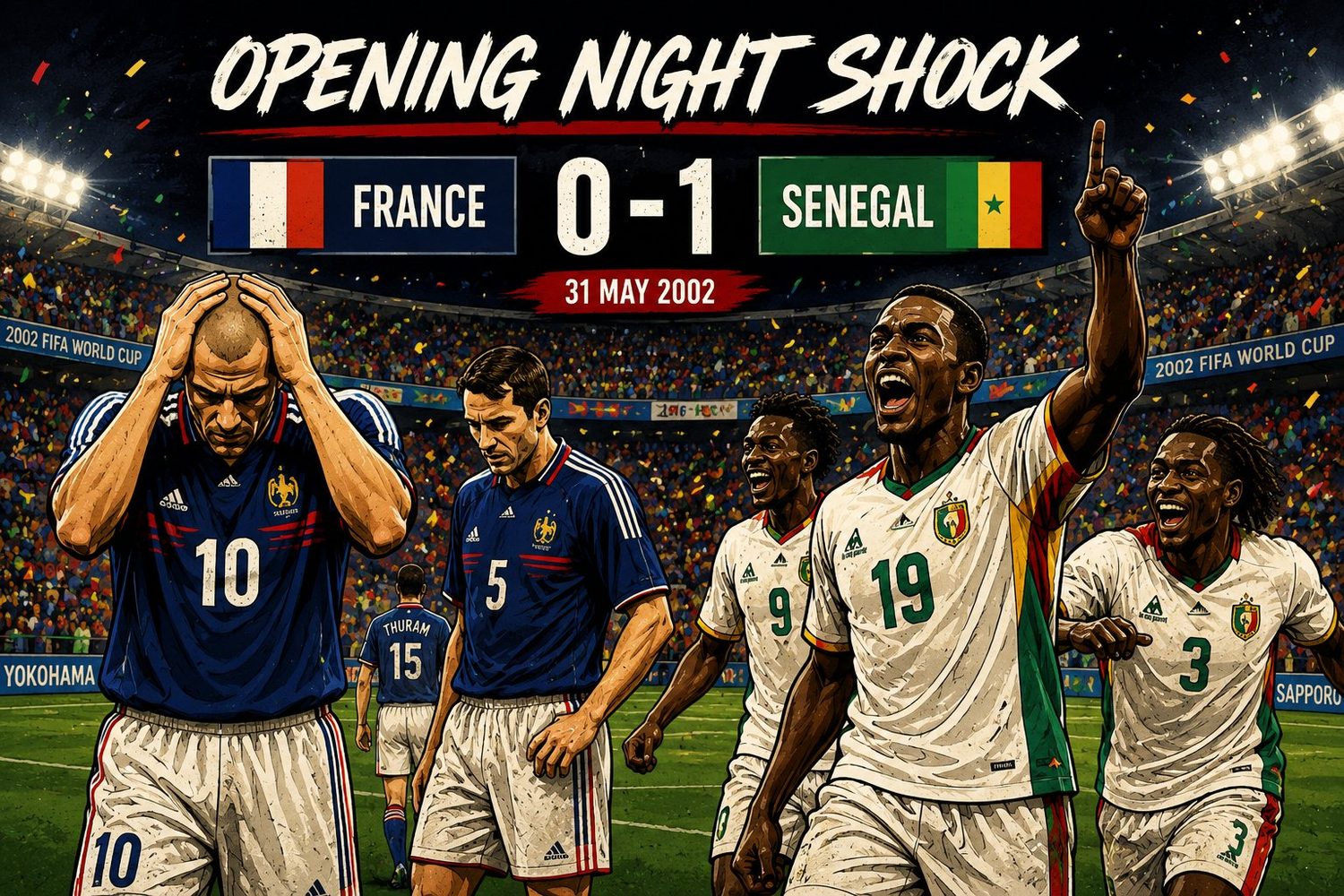
For France it was the start of a humiliation. Zidane, nursing a thigh injury, watched from the sidelines as the holders drew a blank against Uruguay and then lost to Denmark. They were eliminated at the group stage without scoring a goal — one of the most spectacular title defences ever to collapse. Argentina, another pre-tournament favourite, followed them out of the door before the knockouts even began.
This, clearly, had the makings of a World Cup with a difference.The early days in Korea and Japan
The red sea of Korea
If one image survives from 2002, it is the colour red — entire Korean cities turned into oceans of supporters in crimson shirts, the “Red Devils”, roaring through the night. Under the cool, methodical Dutch coach Guus Hiddink, South Korea did what no Asian team had ever done. They reached the semi-finals.
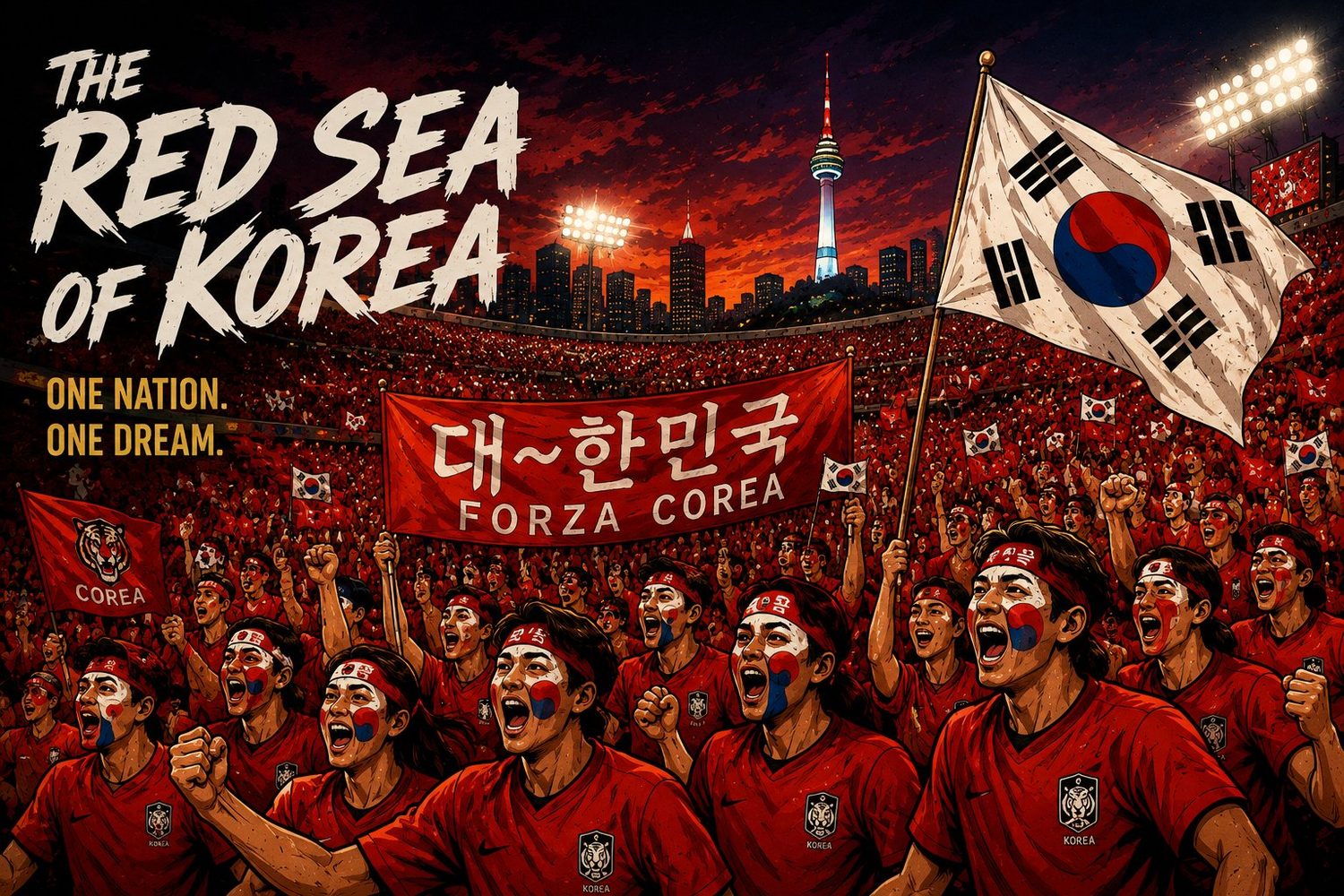
Hiddink had prepared obsessively, keeping his squad together for months and drilling an aggressive, high-pressing 3-4-3 built on relentless running. The results were astonishing. A team that had never won a World Cup match in its history suddenly could not stop winning.
- Group DSouth Korea 2-0 PolandA first-ever World Cup victory, in front of a delirious home crowd.
- Group DSouth Korea 1-1 USAAhn Jung-hwan’s late header rescues a point.
- Group DSouth Korea 1-0 PortugalPark Ji-sung’s winner sends the hosts through as group winners — and Portugal home.
- Round of 16South Korea 2-1 Italy (a.e.t.)Ahn’s golden goal completes a famous, furiously disputed comeback.
- Quarter-finalSouth Korea 0-0 Spain (5-3 pens)Into the last four — the first Asian nation ever to get there.
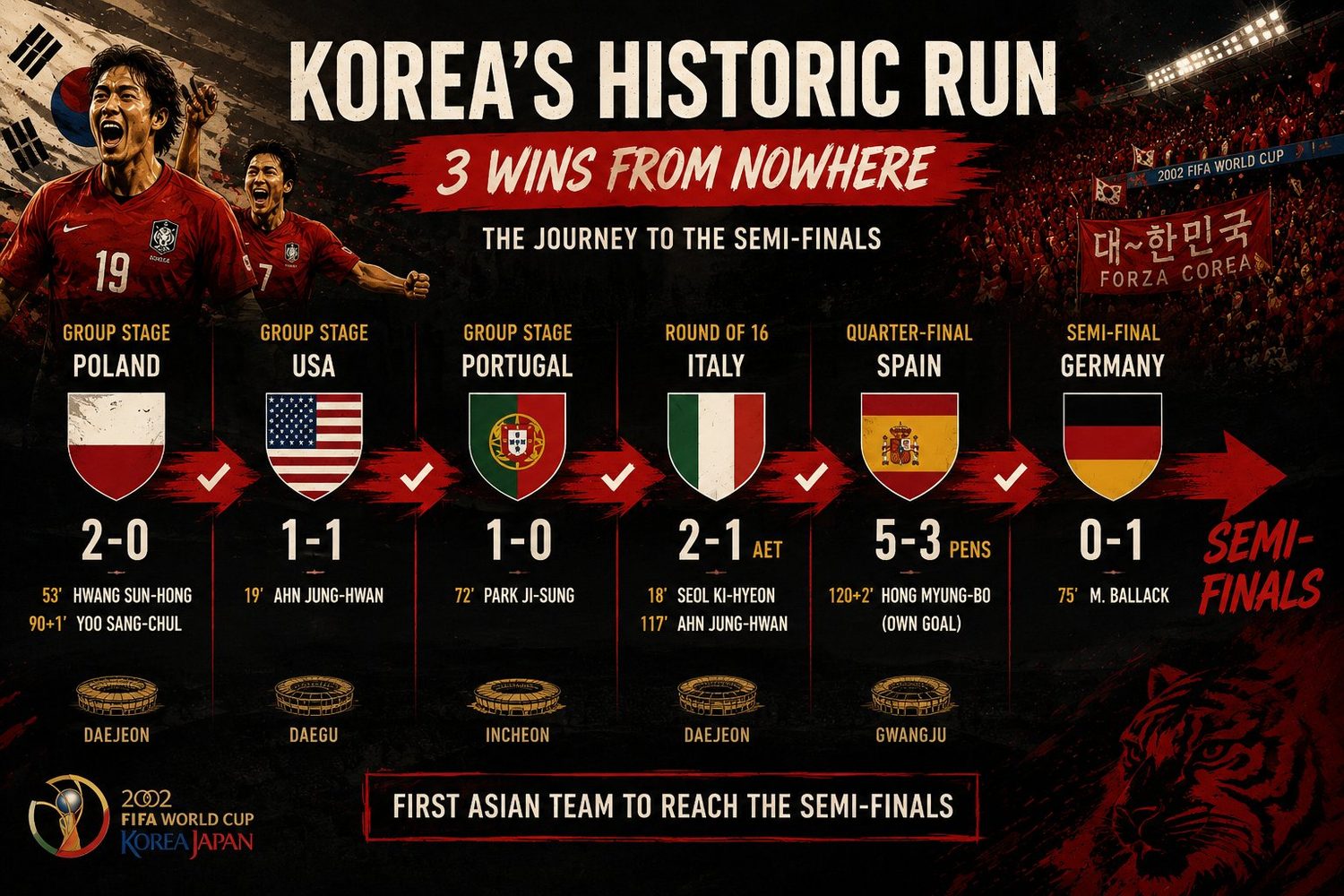
It is impossible to tell the Korean story without the controversy that shadowed it. The knockout wins over Italy and Spain remain two of the most argued-about matches in World Cup history. Against Italy, referee Byron Moreno disallowed a Damiano Tommasi goal and sent off Francesco Totti for a second yellow that replays suggested was harsh; against Spain, two efforts including a Fernando Morientes header were chalked off. Italian and Spanish observers cried foul; defenders of the hosts pointed to Korea’s extraordinary fitness and intensity. Both things can be true — and three World Cups would pass before video review arrived to settle such arguments. What is beyond dispute is the run itself: Germany finally halted it 1-0 in the semi-final through Michael Ballack, and Korea then lost the third-place match to Turkey.
Tens of thousands of fans cheering in the dead of night created quite a sight.On Korea’s home support
R9
Four years earlier, his body had betrayed him on the biggest night of his life. Now he wanted it back.
Ronaldo: the long road back
To understand why 2002 mattered so much to one man, you have to go back to Paris in 1998. Hours before the World Cup final, Ronaldo — the most feared striker on earth — suffered a convulsive fit. His name was pulled from the team sheet, then mysteriously restored. He played as a ghost of himself, and Brazil were beaten 3-0 by France. The questions never really stopped.
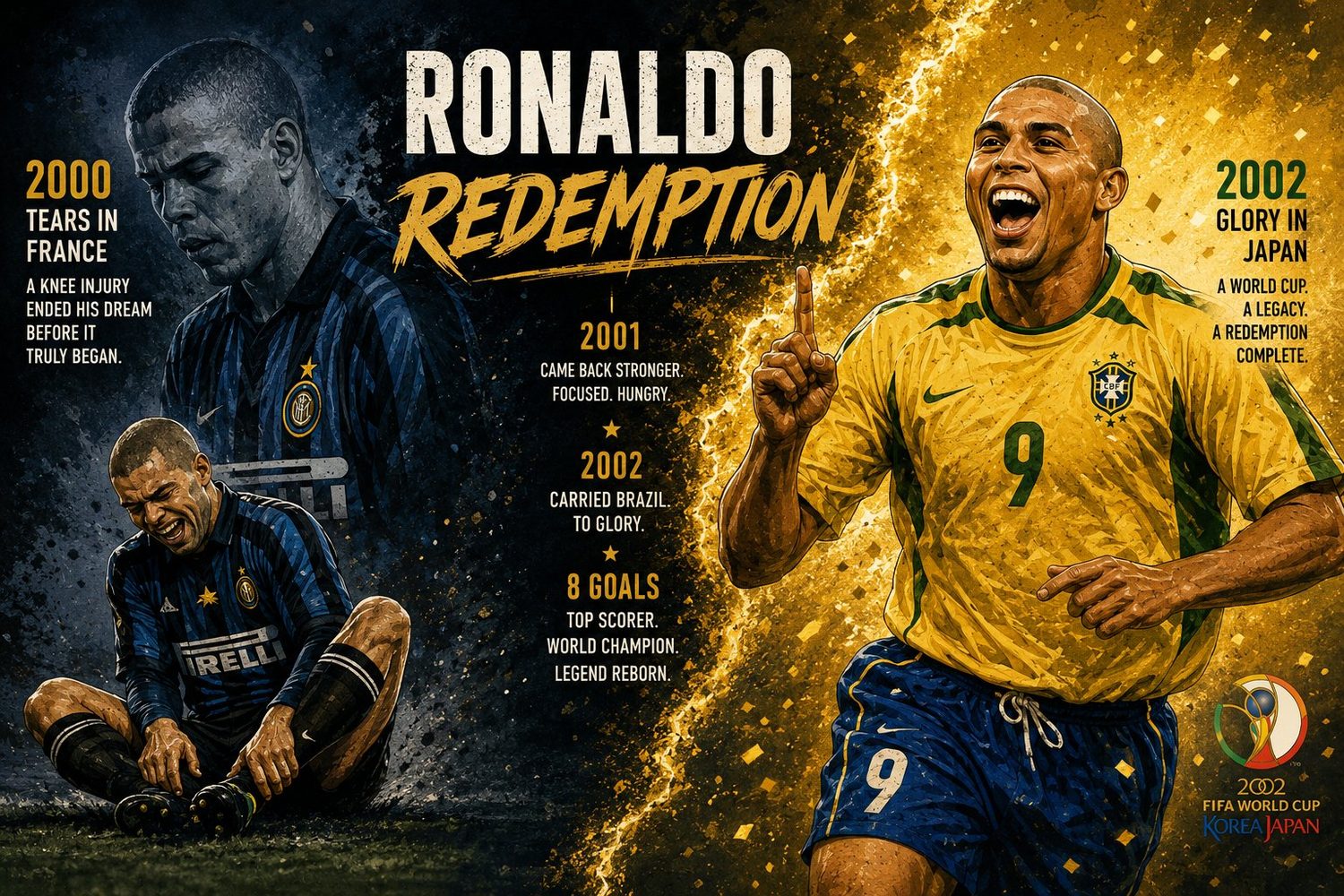
What followed was almost crueller. Serious knee injuries at Inter Milan nearly ended his career; one comeback lasted barely six minutes before his kneecap gave way again. By the time he reached Asia in 2002, sporting that famous wedge of hair he later admitted was meant to distract the world from his fragile legs, few believed he could be the player he once was.
He answered with eight goals — four of them in the group stage alone — to win the Golden Boot. It was the most goals scored at a single World Cup since Gerd Müller in 1970, and it carried him up the World Cup all-time scoring records, where his eventual 15-goal tally stood as the benchmark for years. But the numbers were never really the point. This was a story about a man being given his life’s defining moment back, and refusing to let it pass twice.
I was able to score twice to secure the title and bury the traumas of the previous four years once and for all.Ronaldo
Brazil’s march through the chaos
While the favourites fell around them, Brazil simply kept winning. Luiz Felipe Scolari’s side carried the tournament’s most fearsome attack — the “Three Rs” of Ronaldo, Rivaldo and Ronaldinho — and they tore through their group, beating Turkey, China and Costa Rica to score eleven goals in three games. It was attacking football that helped make 2002 one of the highest-scoring World Cups of the modern era.
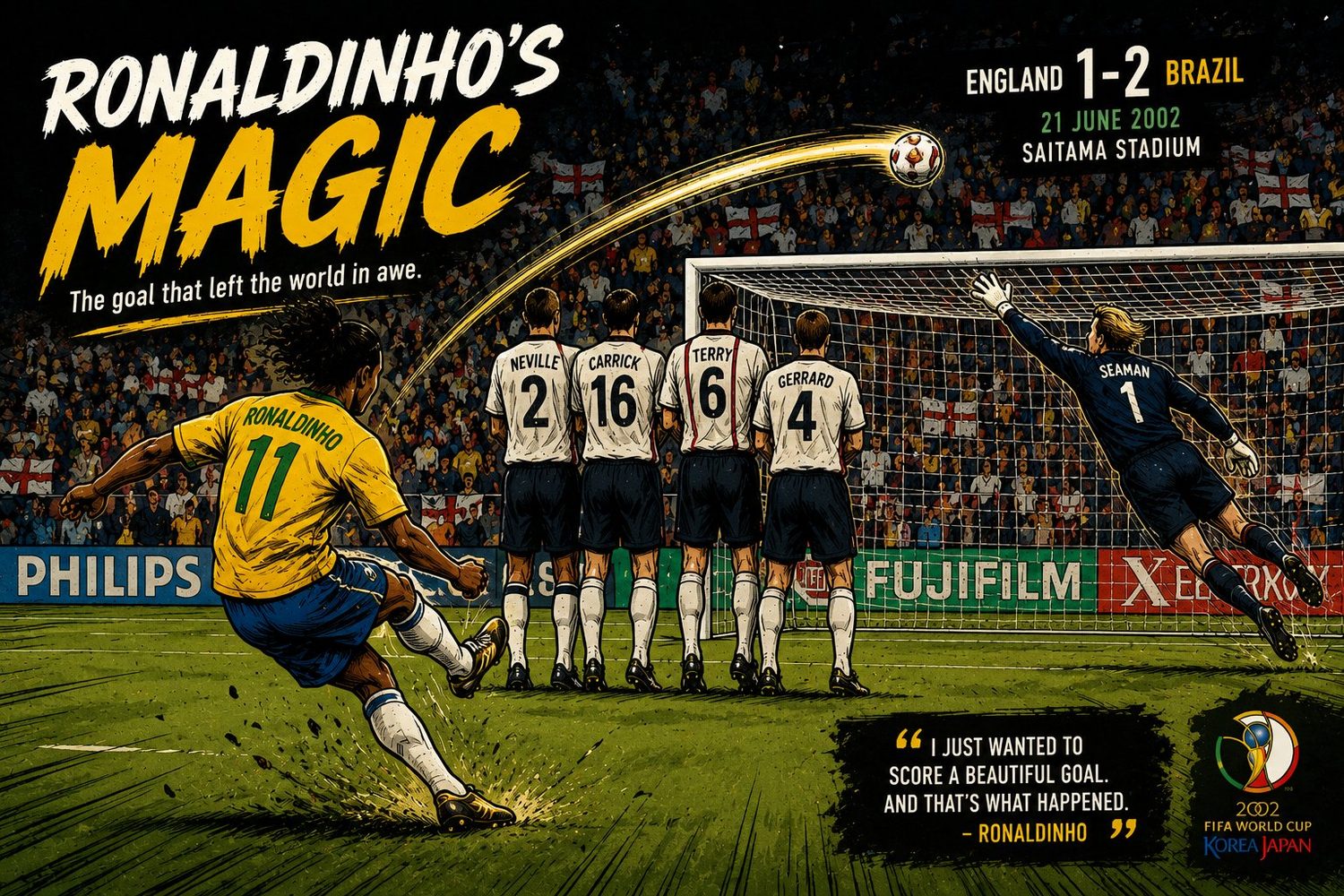
Belgium were dispatched 2-0 in the last sixteen, which set up the quarter-final that England fans still wince at. Michael Owen put England ahead, but Rivaldo equalised before half-time and then, on the stroke of the interval, came the moment of the round: Ronaldinho floated a free-kick from fully forty yards that drifted over the stranded David Seaman and dropped under the bar. Ronaldinho was sent off soon after, but ten-man Brazil held on to win 2-1. Ronaldo’s solitary, slaloming strike then saw off Turkey in the semi-final. Brazil had reached a third consecutive World Cup final.
7Wins from 7 — a perfect run
18Goals scored, tournament’s most
5thWorld title in sight
Yokohama, 30 June
The final pitted Brazil against a stubborn, hard-running Germany — a side carried to the final by the goals of Michael Ballack and the brilliance of goalkeeper Oliver Kahn, who had been close to unbeatable all month. Cruelly, Ballack had been booked in the semi-final and was suspended for the final itself. It would come down to Kahn against Ronaldo.
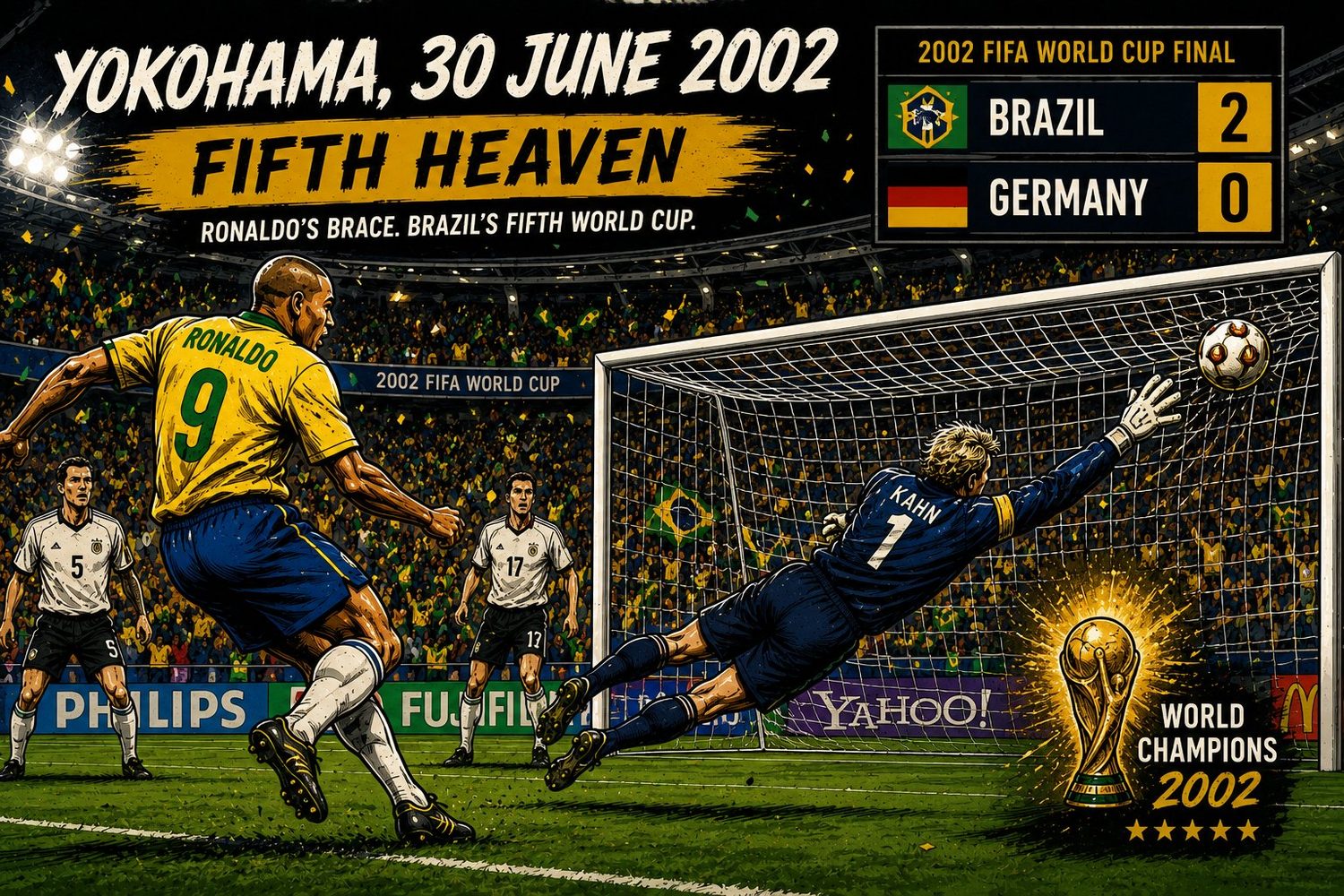
For an hour Germany held. Then, just after the break in the second half, Kahn — for almost the only time in the tournament — spilled a Rivaldo shot, and Ronaldo was there to bundle it in. Twelve minutes later he swept home a second, low into the corner, and the redemption was complete. Kahn, who would still be named the tournament’s best player, sat slumped against his post. Ronaldo wept. Brazil had their fifth star — taking their place at the top of the list of World Cup winners as the most successful nation in the tournament’s history.
Brazil
2–0
Germany
International Stadium Yokohama · Att. 69,029
Ronaldo 67′, 79′
What 2002 left behind
No World Cup is remembered purely for its winner, and this one least of all. Turkey, the tournament’s other revelation, took third place and gave us its most famous statistic when Hakan Şükür scored after barely eleven seconds in the play-off against Korea — the fastest goal in World Cup history. Oliver Kahn became the first, and still the only, goalkeeper to win the Golden Ball as player of the tournament. A young Landon Donovan was named best young player as the United States quietly reached the last eight.
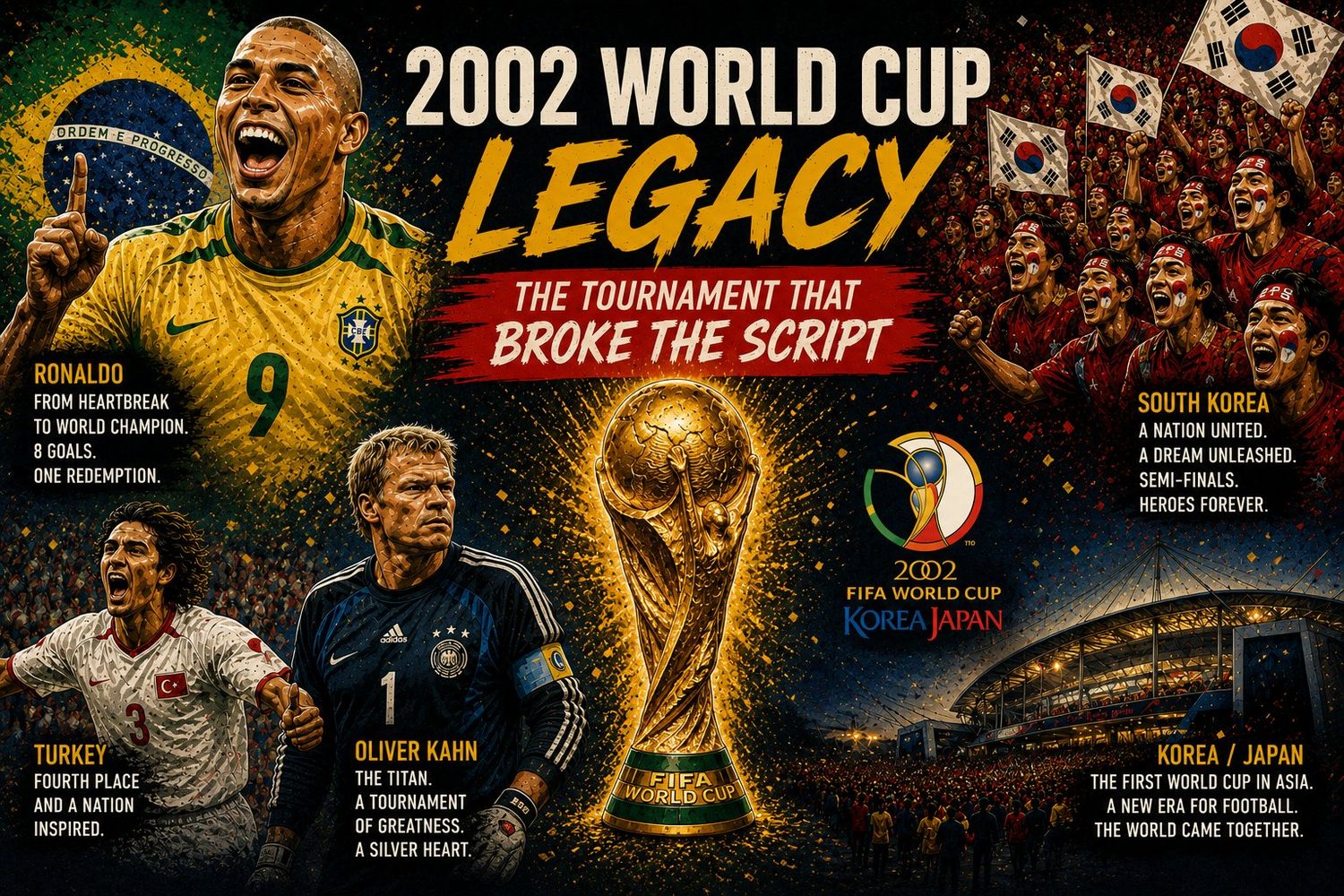
More than any single result, 2002 proved that the World Cup belonged to the whole world. The crowds were vast and joyous, the hosting immaculate, and the football gloriously unpredictable. It opened the door that Qatar would walk through twenty years later — and made the idea of football’s biggest prize travelling anywhere feel not just possible, but overdue. Its twin-nation model would not be revisited until the 2026 World Cup host cities were spread across three countries — with a record 48 qualified teams chasing the trophy that Ronaldo reclaimed in Yokohama.
8Ronaldo’s goals — Golden Boot
1stAsian semi-finalist (Korea)
2.7MTotal attendance
11sŞükür’s record-fast goal
2002 World Cup questions
Who won the 2002 FIFA World Cup?
Brazil won the 2002 World Cup, beating Germany 2-0 in the final in Yokohama on 30 June 2002. It was Brazil’s record fifth world title, with Ronaldo scoring both goals.
Where was the 2002 World Cup held?
The 2002 World Cup was co-hosted by South Korea and Japan from 31 May to 30 June 2002. It was the first World Cup held in Asia, the first staged outside Europe or the Americas, and the first shared by two host nations, played across 20 stadiums.
Who won the Golden Boot at the 2002 World Cup?
Ronaldo of Brazil won the Golden Boot as top scorer with eight goals — the most at a single World Cup since Gerd Müller in 1970. The haul also helped redeem his nightmare of the 1998 final.
How far did South Korea get in the 2002 World Cup?
Co-hosts South Korea reached the semi-finals under Guus Hiddink, becoming the first Asian nation ever to do so. They beat Italy and Spain in the knockout rounds before losing 1-0 to Germany, then finished fourth after a 3-2 defeat to Turkey in the third-place match.
Who was named the best player of the 2002 World Cup?
Germany goalkeeper Oliver Kahn won the Golden Ball as the tournament’s best player — the first and so far only goalkeeper ever to receive the award, despite his costly error in the final.
What was the score in the 2002 World Cup final?
Brazil 2-0 Germany, played at the International Stadium in Yokohama in front of around 69,000 fans. Ronaldo scored both goals, in the 67th and 79th minutes.
Why did France get knocked out of the 2002 World Cup so early?
Reigning champions France were eliminated in the group stage without scoring a single goal, losing their opener 1-0 to debutants Senegal, drawing with Uruguay and losing to Denmark. Zinedine Zidane missed the early matches through injury.
Why was the 2002 World Cup hosted by two countries?
South Korea and Japan had submitted rival bids to host. Rather than choose between two nations with a difficult shared history, FIFA awarded them joint hosting rights in 1996 — making 2002 the first co-hosted World Cup in the tournament’s history.

About the author: Fiona Harvey
Fiona Harvey is a football journalist and content writer with a passion for the global game. She specialises in covering major tournaments, football history, player profiles and the latest developments from across the sport. Her work combines in-depth research with engaging storytelling, delivering insightful articles for football fans around the world. With experience producing digital football content, Fiona has written…