
The 2026 World Cup isn’t just bigger — it’s built differently. So how does the 2026 World Cup work now that it has grown beyond anything the tournament has staged before? The headline change is the move to a 48 team World Cup, the largest expansion in the competition’s history, replacing the 32-team setup that ran from 1998 to 2022.
Here’s the 2026 World Cup format explained in short. Those 48 nations are split into World Cup 2026 groups — twelve groups of four. The top two from each group advance automatically, joined by the eight best third-placed teams, which sends 32 sides into the knockout phase. That creates a brand-new stage the tournament has never had: the Round of 32 World Cup knockout round, sitting ahead of the familiar Round of 16, quarter-finals, semi-finals and final.
The practical upshot is that the eventual champion now plays eight matches rather than seven. Below, we break down the full 2026 World Cup format step by step — how the groups work, how that tricky “best third-placed teams” rule is decided, why FIFA expanded the tournament, and what the new structure means for the teams chasing the trophy.

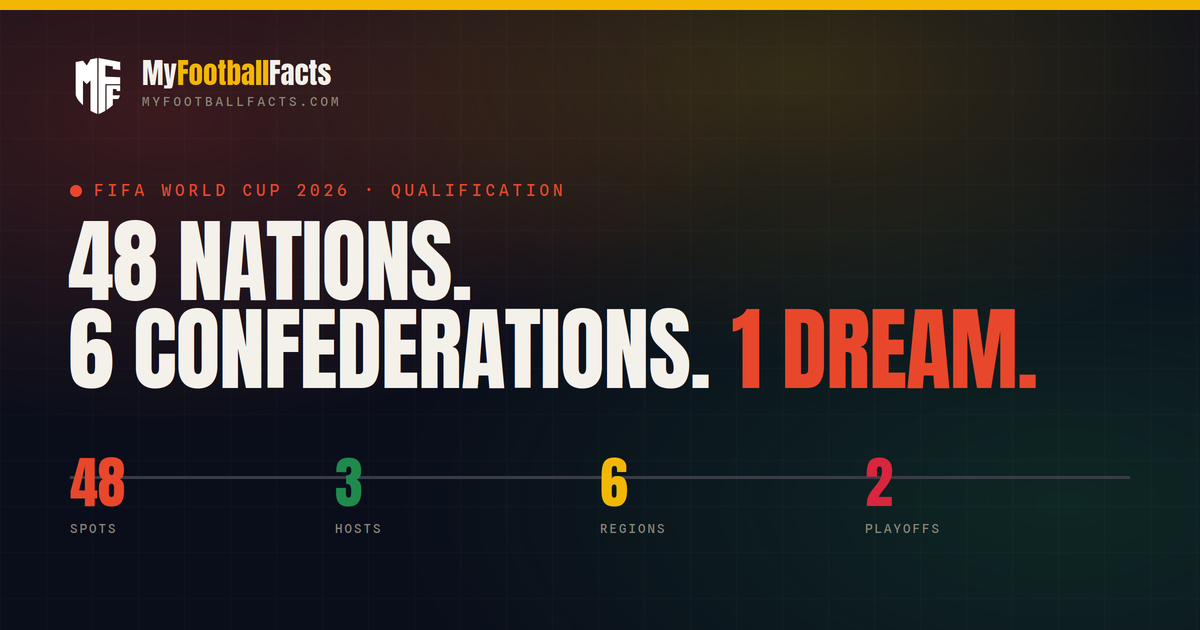
2026 World Cup Qualified Teams — 48 Nations.
6 Confederations.
One Dream.
For the first time, 48 nations reach the finals. Here is how the places are shared across the six confederations — and where the surprise qualifiers are coming from.
Who Has Qualified for the 2026 World Cup?
For the first time, 48 nations will reach the World Cup finals. The three host countries — the United States, Mexico and Canada — qualified automatically, and the remaining places are allocated across the six continental confederations, with two spots decided by an intercontinental play-off tournament.
The expansion means more nations than ever have a realistic path to football’s biggest stage, including several chasing a first-ever appearance.
Qualification Slots By Confederation
Fig. 01 — How the 48 Are Allocated
UEFA (Europe)16CAF (Africa)9AFC (Asia)8CONMEBOL (S. America)6CONCACAF (N. America)6*OFC (Oceania)1Play-off berths2
*CONCACAF total includes the three automatic host places (USA, Mexico, Canada).
The hosts: in by right
As co-hosts, the USA, Mexico and Canada all take their places automatically. For Canada it is only a third-ever men’s World Cup appearance; for Mexico, a record stretch of consecutive tournaments continues; and the USA will look to make a deep run on home soil.
Europe’s 16 and the heavyweights
UEFA carries the largest allocation with 16 places, ensuring the usual contenders — the reigning powers of world football among them — will be present. With so many berths, qualification drama in Europe centres less on whether the giants get there and more on which surprise package sneaks through.
New faces and first-timers
The jump to 48 teams has opened the door for nations from Africa, Asia and the smaller confederations that have never qualified before. Expect at least a handful of debutants — one of the most compelling storylines of the expanded format, and exactly the outcome FIFA hoped for in widening the field.
The intercontinental play-offs
Two of the final places will be settled by a six-team play-off tournament staged shortly before the finals, bringing together teams from five confederations. It is a high-stakes mini-event that can send a nation to the World Cup on the strength of a single match.
More on the 2026 World Cup