




The 2026 FIFA World Cup will be the biggest tournament in football history. 48 teams, 104 matches, and three host nations spread across the USA, Canada, and Mexico. With qualification well underway, the question on every fan’s mind is simple: who is going to win it? Here’s our World Cup 2026 predictions as we look at the contenders, the dark horses, and the teams who could shock the world.
The Heavy Favourites
Brazil and France sit at the top of most prediction models, and for good reason. Brazil have rebuilt impressively since their disappointing 2022 quarter-final exit, with a generation of attacking talent led by Vinícius Júnior, Rodrygo, and the teenage prodigy Endrick. France remain a tournament machine under Didier Deschamps’s successor, with Mbappé still in his prime and one of the deepest squads in world football. Either would surprise nobody by lifting the trophy in New Jersey.
Argentina: Can They Defend?
Defending champions almost never repeat. Only Italy (1934, 1938) and Brazil (1958, 1962) have ever done it. But Argentina go into 2026 with momentum, a settled spine, and the small matter of Lionel Messi possibly playing one last World Cup at 39. Lautaro Martínez, Julián Álvarez, and Enzo Fernández give them genuine quality even without Messi at his peak. They start as third-favourites and would be considered a major threat in any era.
The European Pack
Behind the top three, a cluster of European nations all carry realistic hopes. England’s golden generation finally has tournament experience after consecutive deep runs. Spain’s young core, led by Lamine Yamal and Pedri, looked devastating en route to Euro 2024. Germany are rebuilding under fresh management and remain ever-dangerous. Portugal will likely have one last dance with a slightly older Cristiano Ronaldo. The Netherlands have the kind of balanced squad that often outperforms its pre-tournament odds.
Dark Horses to Watch
Morocco’s stunning run to the 2022 semi-finals proved the gap between traditional powers and the rest is closing. Their squad has only deepened since. Croatia continue to defy demographics with their generation of midfielders. Belgium have transitioned from their golden generation but still possess elite quality. And keep an eye on Uruguay under Marcelo Bielsa: chaotic, brilliant, and capable of beating anyone on their day.
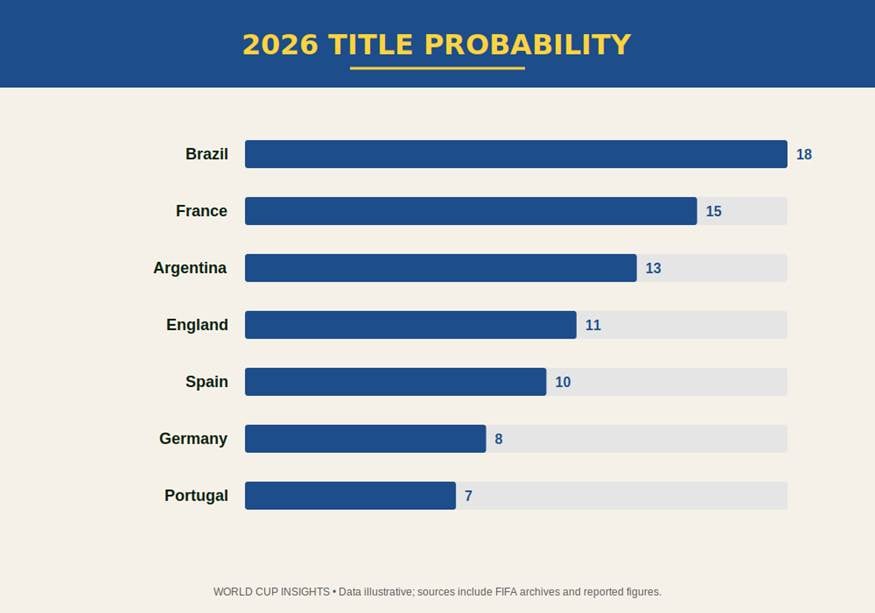
Infographic: 2026 Title Probability infographic
The Host Nation Factor
Hosts historically over-perform. Mexico are seeded comfortably and will play key matches at altitude in Mexico City, a significant advantage. The USA enter a home tournament with their strongest squad in a generation, headlined by Christian Pulisic, Gio Reyna, and Yunus Musah. While outright victory may be a stretch, a deep run by either CONCACAF nation feels plausible. Canada, third co-host, are unseeded but improving rapidly.
Format Changes Affect Predictions
With 48 teams in 12 groups of 4, and a new Round of 32 stage, the path to the final is longer than ever. Eight knockout rounds for the eventual winners, compared to seven previously. This favours nations with squad depth and the ability to rotate. It also creates more opportunities for cup-tie shocks. Don’t be surprised if at least one traditional power exits before the quarter-finals.
Our Top 5 Picks
Putting it all together: Brazil and France lead, with Argentina close behind. England and Spain round out our top five. Beyond those, we’d rate Morocco and the Netherlands as the most likely to make a deep, unexpected run. Whoever lifts the trophy on July 19, 2026, in New Jersey will have earned it. This is the most competitive World Cup field ever assembled.
The Statistical Models
Modern World Cup predictions blend traditional football scouting with statistical models. Elo ratings, expected-goals projections, market-implied probabilities, and simulation engines that run the tournament thousands of times. The leading models broadly agree on the favourites but diverge sharply on the second tier. Brazil and France are typically given between 12% and 20% chance of winning; outside the top five, no nation usually exceeds 4%. The expansion to 48 teams complicates the math: more matches mean more variance, and more variance means more opportunities for shock results. Anyone telling you they know the winner with confidence is overconfident. But the data does point clearly to the likely contenders.
Final Thought
The 2026 World Cup will be the broadest, most competitive, and most logistically complex tournament ever staged. Picking a winner is harder than it has ever been, and that’s precisely what makes the build-up so compelling. Whatever your predictions, the only certainty is that we’ll all be surprised by something.
Conclusion
Predictions are an inexact science, especially at a tournament expanded to 48 teams for the first time. But the broad shape is clear: a small elite, a wide chasing pack, and more genuine contenders than ever before. Football is the winner.