


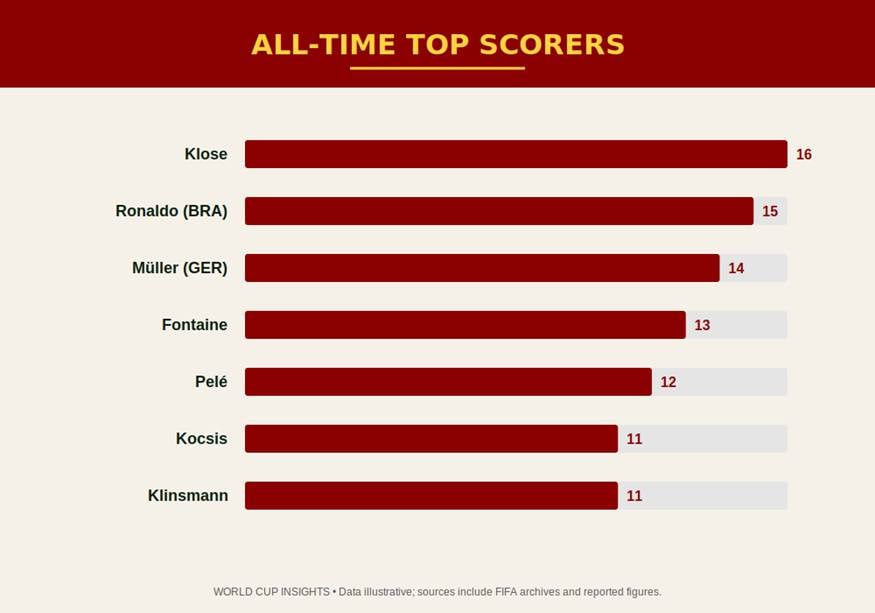
- 1. Miroslav Klose (Germany), 16 goals
- 2. Ronaldo (Brazil), 15 goals
- 3. Gerd Müller (Germany), 14 goals
- 4. Just Fontaine (France), 13 goals
- 5. Pelé (Brazil), 12 goals
- 6. Sándor Kocsis (Hungary), 11 goals
- 7. Jürgen Klinsmann (Germany), 11 goals
- 8. Cristiano Ronaldo (Portugal), 8 goals
- 9. Lionel Messi (Argentina), 13 goals
- 10. Helmut Rahn (West Germany), 10 goals
- The Modern Striker Drought
- The Active Threats for 2026
- Conclusion
Scoring at a FIFA World Cup is the ambition of every striker, but lifting yourself into the all-time top scorers list is a feat reserved for a tiny elite. These ten players, across nearly a century of competition, have written their names into World Cup history with their all-time World Cup goals. Here are the leading marksmen the tournament has ever produced.
1. Miroslav Klose (Germany), 16 goals
The German striker reached 16 in four tournaments (2002-2014), overtaking Ronaldo in the semi-final of Brazil 2014. That was the famous 7-1 demolition of the hosts. Klose’s record is built on consistency rather than fireworks. He was never the tournament’s top scorer in any single edition, but consistently effective from his debut in 2002 to his crowning glory at age 36. He played in four finals and won the trophy at the last.
2. Ronaldo (Brazil), 15 goals
Not Cristiano. “O Fenômeno”. Three tournaments, two finals, one trophy, and one of the great redemption arcs in football history. After the mysterious illness that derailed him in the 1998 final, Ronaldo returned in 2002 to score eight goals, including both in the final against Germany. He added three more in 2006 to surpass Gerd Müller’s long-standing record, before Klose moved past him eight years later.
3. Gerd Müller (Germany), 14 goals
“Der Bomber” needed only two tournaments to reach his total. He won the Golden Boot at Mexico 1970 with 10 goals, still a phenomenal single-tournament return, and added four more on home soil in 1974, including the winner in the final against the Netherlands. For decades he held the all-time record. He remains the most efficient elite scorer in tournament history.
4. Just Fontaine (France), 13 goals
The most remarkable number on this list. Fontaine scored all 13 of his goals at a single tournament, Sweden 1958, in just six matches. It is a record that has stood for over 65 years and is unlikely ever to be broken in the modern era of squad rotation and tactical caution. France finished third, and Fontaine retired at 28 due to injury, never adding to his total.
5. Pelé (Brazil), 12 goals
Pelé played in four World Cups and won three of them, a unique achievement. His 12 goals across 14 matches feels modest by his standards, but they came at decisive moments: two in the 1958 final as a 17-year-old, two against Sweden, four in 1970 including one in the final. He is the only player to win three World Cup trophies.
6. Sándor Kocsis (Hungary), 11 goals
Another single-tournament wonder. Kocsis scored 11 goals at Switzerland 1954, including consecutive hat-tricks, as part of the legendary “Mighty Magyars” side that lost the final to West Germany. He never played at another World Cup, having defected from Hungary after the 1956 uprising.
Infographic: All-Time Top Scorers infographic
7. Jürgen Klinsmann (Germany), 11 goals
Three tournaments, three deep runs, eleven goals. Klinsmann was the archetype of the modern striker: quick, clever, and ruthless inside the box. He won the trophy in 1990 and captained Germany to a semi-final on home soil in 2006 as their manager.
8. Cristiano Ronaldo (Portugal), 8 goals
The other Ronaldo. Across five tournaments (2006-2022), Cristiano has scored at every single one, a unique achievement. His total is held back by Portugal’s tendency to exit in the round of 16 or quarter-finals, but his longevity is unprecedented. He has another World Cup possibly to come.
9. Lionel Messi (Argentina), 13 goals
Messi’s 2022 surge, seven goals on the way to the title including two in the final, finally pushed him into the elite. Across five tournaments he has scored 13 goals and provided eight assists, with his crowning moment coming at age 35 in Qatar. He may yet add to the tally in 2026.
10. Helmut Rahn (West Germany), 10 goals
The hero of the 1954 “Miracle of Bern” final, Rahn scored 10 World Cup goals across two tournaments. His winner against Hungary remains one of the most consequential goals in the game’s history. It changed not just a final but a nation’s post-war psyche.
The Modern Striker Drought
One striking pattern across recent tournaments: no single striker has dominated since Klose’s 2014 finish. The 2018 Golden Boot went to Harry Kane with six goals (most from penalties), 2022 to Kylian Mbappé with eight (a high-quality tournament but well short of historic totals). The decline reflects the modern game’s broader trend. Fewer high-volume strikers, more goals spread across teams. Whether the 2026 tournament produces a true superstar finisher remains to be seen, but the expanded format does at least offer the chance for one striker to reach the historical heights of Fontaine, Müller, and Ronaldo.
The Active Threats for 2026
Kylian Mbappé arrives at 27, already on 12 World Cup goals. Harry Kane sits on 8 with another tournament coming. Erling Haaland’s Norway are in genuine qualification contention. Each could climb several places on this list by the end of 2026. Though catching Klose’s 16 will require a deep tournament run.
Conclusion
These ten players span 70+ years of World Cup history, but share one defining trait: the ability to deliver in football’s most pressurised environment. With Kylian Mbappé already on 12 goals at just 26, that list may need updating soon.