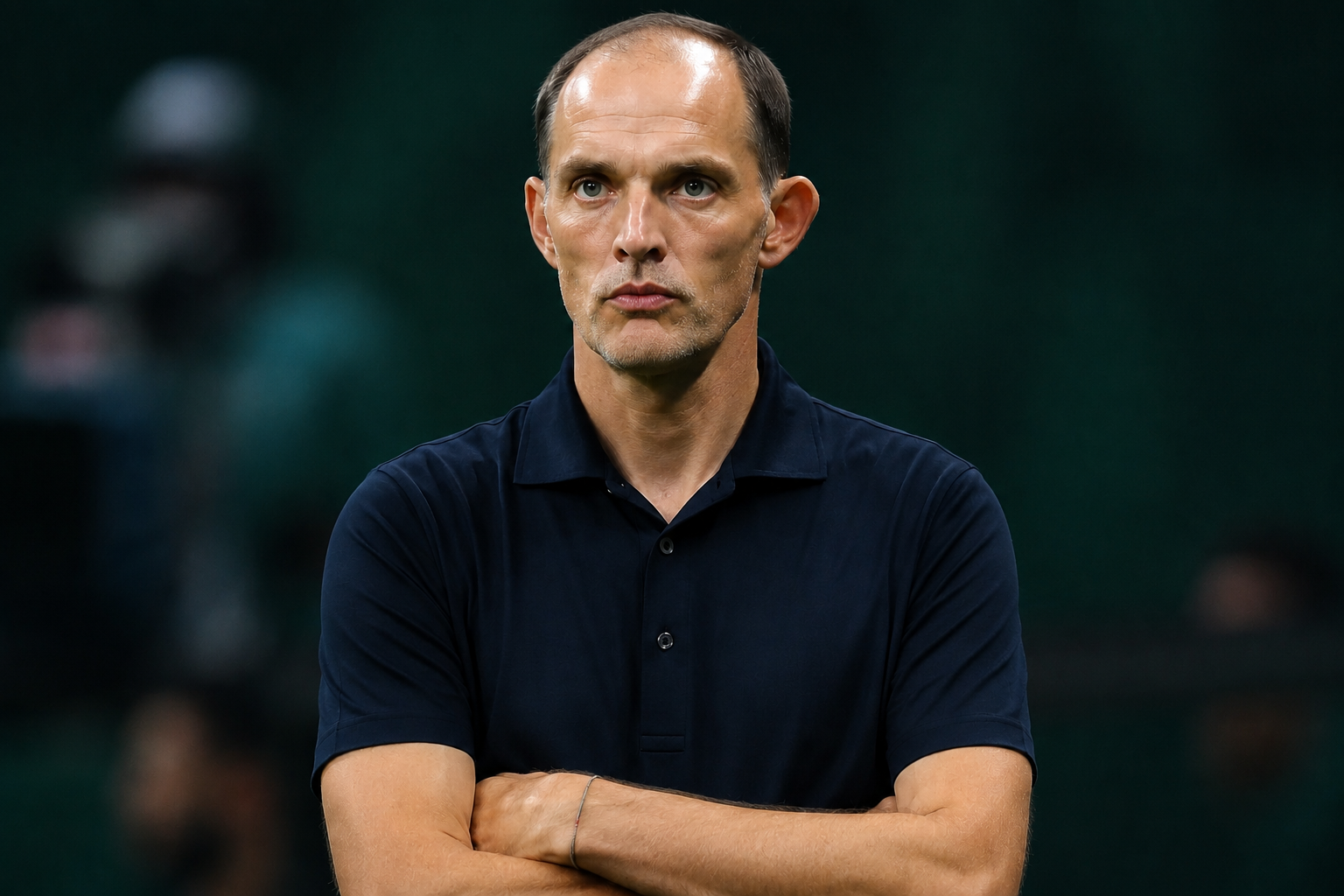

England were 30 minutes from a first World Cup final in 60 years when the game, and the narrative, turned. Anthony Gordon’s 55th-minute goal in Atlanta had the Three Lions in front, only for Enzo Fernandez and Lautaro Martinez to strike late and send holders Argentina through 2-1. Within minutes of the final whistle, the loudest conversation was not about Lionel Messi. It was about Thomas Tuchel.
The Thomas Tuchel backlash was immediate and loud. The defeat added another agonising chapter to the England v Argentina head-to-head record, but the post-match focus quickly narrowed to one decision: with a lead to protect, England stopped attacking, dropped into a back five and invited the world champions onto their goal. The charge from critics is that Tuchel got the biggest call of the night wrong. The defence is that a tired team, the greatest player of all time and the finest of margins tell a more complicated story. So was the backlash warranted?
The short version
- England led 1-0 through Gordon before conceding twice in the last five minutes plus stoppage time.
- Tuchel switched to a back five and dropped deep, sending on Ezri Konsa, Dan Burn and Nico O’Reilly late on.
- England averaged around 12% possession from the goal until Martinez’s winner, with Messi assisting both Argentina goals.
- Pundits called the approach a gamble that backfired. Tuchel accepted England were too passive but said he had “no regrets”.
What changed after Gordon scored
For an hour this was a cagey, physical contest with almost nothing between the sides. The breakthrough came when Morgan Rogers delivered a low cross from the right and Gordon arrived at the back post to finish past Emiliano Martinez. England, the underdogs, were in front against the reigning champions.
Rather than press for a second goal that might have settled it, England went the other way. Tuchel reshaped his side into a back five, withdrew the goalscorer Gordon and introduced defensive reinforcements across the closing 20 minutes. The intent was to close the gaps he felt Argentina were exploiting and to be stronger in the air. In practice, England surrendered the initiative almost entirely.
12%England’s average possession after taking the lead
5-4-1The deep block England retreated into late on
2Messi assists in the closing minutes
Argentina laid siege. Jordan Pickford saved brilliantly from a Nico Gonzalez header, Alexis Mac Allister headed against the post, and the pressure eventually told. Fernandez levelled with a superb strike from distance on 85 minutes, and in stoppage time Messi recycled a loose ball and crossed for substitute Martinez to head the winner. A game England had controlled on the scoreboard slipped away because they stopped trying to control it on the pitch.
The case that the backlash was warranted
The criticism from former players and analysts was close to unanimous, and it was rooted in what the game actually showed rather than pure emotion. Gary Lineker described the decision to sit so deep against Messi as unfathomable, the point being that dropping off simply hands the world’s best player the time and space he thrives on.
On commentary, Alan Shearer noted England finished with “six defenders on the pitch” and argued that a plan to hang on, which had worked against Mexico and Norway, was far riskier against a side with Argentina’s quality and ruthlessness. Wayne Rooney’s observation cut to the psychology of it: attacking players who see wave after wave of defensive substitutions start to lose belief, and a team can only cling on for so long. Gary Neville and Ian Wright made the same tactical point from the other side, that inviting crosses and bodies into your own box is exactly the chaos Messi wants to create. Joe Hart read the early switch as the manager signalling he no longer trusted his team to score again, while on the United States broadcast Zlatan Ibrahimovic simply felt England stopped playing the moment they scored.
What sharpens the criticism is the pattern. England supporters have watched leads protected too passively before, from the 2018 semi-final against Croatia to the Euro 2020 and Euro 2024 finals. The fear voiced after Atlanta was that a new manager, hired partly for his tactical boldness, had reached for the same cautious instinct at the decisive moment. A run of pre-match friction between Tuchel and Jude Bellingham, which had shadowed the build-up after the Norway win, only added to the sense of a story ready to turn negative.
The case in Tuchel’s defence
The counter-argument does not deny the retreat was risky. It sets the risk in context.
Fatigue was real and it was earned the hard way. England’s knockout run took them to altitude at the Estadio Azteca, where they beat Mexico with ten men, and then into fierce Miami heat for 120 minutes against Norway. By the time Argentina turned the screw, several England players were visibly spent. Even Martinez, Argentina’s match-winner, suggested England had pressed hard for an hour and had little left in the closing stages. A deep block was, in part, a response to legs that were gone.
There is also the identity of the opponent. Argentina are world champions and the tournament’s great escapologists, scoring repeatedly in the final 15 minutes across the finals. Conceding a late equaliser to that team, from a Fernandez strike of real quality and a set-piece Messi recycled, is not on its own proof of a unique English failing. Mac Allister hit the post, Pickford made saves, and the winner arrived deep into stoppage time. Defender Dan Burn’s framing, that Argentina carried the calm of a side that had been there and done it, was more than a soundbite.
Then there is the bigger picture. This was Tuchel’s first tournament in charge, and he led England to the semi-finals, only the fourth England manager to reach a World Cup last four after 1966, 1990 and 2018. You can trace that whole journey, and where it sits historically, on the England managers records page, which now lists Tuchel’s tenure alongside every predecessor. Losing a semi-final by a single stoppage-time goal to the holders is a fine performance by most reasonable measures, even if it does not feel that way the morning after.
In his post-match reaction, shown in full below, Tuchel took full responsibility for the defeat while standing by the thinking behind his changes.
Thomas Tuchel gives his full reaction to England’s semi-final exit. Video: Sky Sports News.
So, was the backlash warranted?
It helps to separate two different things that the word backlash tends to blur together.
The tactical criticism: largely fair
On the specific decision, the critics have a strong case. Around 12% possession and almost no presence in the final third after the last defensive change is not game management, it is a surrender of initiative. Against a team built around Messi, ceding the ball and defending your own box for 30 minutes is a gamble with poor odds, and it is one Tuchel has effectively acknowledged by admitting his side became too passive.
The wider verdict: often disproportionate
Where the reaction overreaches is when it treats the tournament as a failure or questions whether Tuchel is the right man. A first-time England manager reaching a World Cup semi-final, beating Mexico at the Azteca along the way and losing narrowly to the champions, is not a crisis. Criticise the 20 minutes, not the two years.
The fair conclusion is that the Thomas Tuchel backlash is warranted as tactical critique and unwarranted as a referendum on his suitability. The late retreat was a genuine mistake, and one the manager has been honest about. Whether it hardens into a defining flaw or becomes a lesson will be answered at Euro 2028, which England co-host, and which Tuchel has confirmed he will lead.
What next for England
Before that, there is unfinished business at these finals. England face France in the third-place play-off, their first appearance in that fixture since 2018, while Argentina go on to meet Spain in the final. Tuchel confirmed after the semi-final that he will stay on through to Euro 2028, co-hosted by England, Scotland, Wales and the Republic of Ireland, giving him a home tournament to build towards. For a fuller picture of how this campaign compares with previous runs, the England national team hub collects the records, results and milestones in one place.
Thomas Tuchel Backlash FAQs
Here are answers to the most common questions about the criticism of Thomas Tuchel following England’s 2026 World Cup semi-final defeat to Argentina.
Why did Thomas Tuchel face a backlash after England v Argentina?
Because England switched to a back five and dropped deep after Anthony Gordon’s goal, conceding the initiative before losing 2-1 to late goals from Enzo Fernandez and Lautaro Martinez. Many pundits and supporters felt the passive approach cost England a place in the final.
What did Tuchel say about his tactics?
Tuchel accepted that the responsibility for such decisions sits with the coach and admitted England were too passive after taking the lead, but he insisted he had no regrets about trying to close the gaps he felt Argentina were exploiting.
How much possession did England have after taking the lead?
England averaged around 12% possession from Gordon’s 55th-minute goal until Martinez’s stoppage-time winner, spending most of the closing half-hour defending inside their own box.
Did England’s players criticise the approach?
Captain Harry Kane admitted the side simply tried to hold on once ahead, which at that level is not enough. Others, including Dan Burn, pointed instead to fine margins and Argentina’s greater tournament experience.
Was the criticism of Tuchel fair?
The tactical criticism is well supported by the numbers, but framing the whole tournament as a failure is widely seen as harsh. England reached the semi-finals in Tuchel’s first tournament in charge and lost by a single stoppage-time goal to the world champions.
Is Thomas Tuchel still England manager?
Yes. Tuchel confirmed after the defeat that he will remain in charge through to UEFA Euro 2028, which England co-host alongside Scotland, Wales and the Republic of Ireland.
Who do England play next?
England face France in the third-place play-off, their first since 2018, while Argentina meet Spain in the 2026 World Cup final.