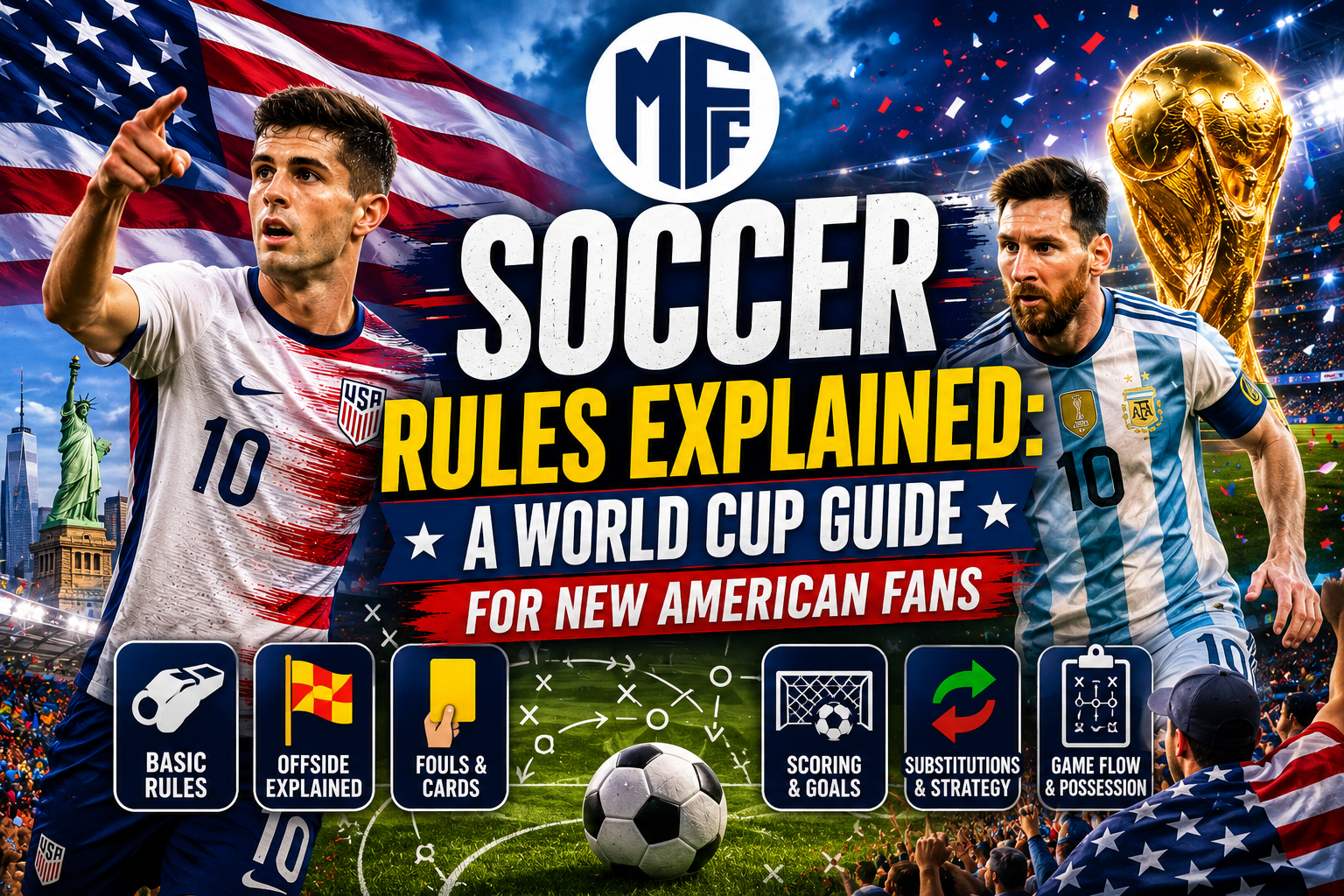
New to soccer and watching your first World Cup? You are not alone. Millions of Americans are tuning in for the first time this summer, and the rules can seem confusing at first. Here is everything you need to follow the tournament like a lifelong fan, from offside to penalty shootouts.
The Basics: How a Soccer Game Works
A match lasts 90 minutes, split into two 45-minute halves. The clock counts up, not down, and it never stops. Instead, the referee adds “stoppage time” at the end of each half to make up for injuries, substitutions and other delays, which is why you will see games run to 45+4 or 90+8. In the group stage, a tie is a perfectly normal result: teams get three points for a win, one for a tie and none for a loss.
What Is Offside?
Offside is the rule that confuses new fans most, but the core idea is simple. When the ball is passed forward to an attacker, that attacker must have at least two opponents (usually the last defender plus the goalkeeper) between themselves and the goal at the moment the pass is played. If they are beyond the last defender when the ball is kicked, the flag goes up and the attack is stopped. It exists to stop players simply camping next to the goal waiting for long balls.
Cards and Suspensions
A yellow card is a formal warning; two yellows in one game make a red, and a straight red card means immediate ejection with no replacement allowed, leaving the team to play with 10 men. Red cards also carry a suspension for the next match, which is why the USA had to plan for their Round of 16 tie without leading scorer Folarin Balogun after his red card against Bosnia and Herzegovina.
How the World Cup 2026 Format Works
| Stage | How It Works |
|---|---|
| Group stage | 48 teams in 12 groups of four, each team plays three games |
| Who advances | Top two in each group plus the eight best third-place teams |
| Round of 32 | New knockout round introduced in 2026, 16 matches |
| Round of 16 to final | Single-elimination bracket down to the July 19 final |
From the knockout rounds onward there are no ties. If a game is level after 90 minutes, the teams play 30 minutes of extra time, and if it is still level, the match goes to a penalty shootout: five kicks per team from the penalty spot, then sudden death. For the full breakdown of the expanded tournament, see our 2026 World Cup format explained guide, and check every remaining date in our 2026 World Cup schedule.
Soccer Rules FAQs
Here are short answers to the rules questions new World Cup viewers ask most often.
Why does the clock count up in soccer?
The clock runs continuously from 0 to 90 minutes and never stops. Lost time is added back by the referee as stoppage time at the end of each half.
What happens if a World Cup knockout game ends in a tie?
The teams play 30 minutes of extra time. If the score is still level, the game is decided by a penalty shootout.
How many teams are in the 2026 World Cup?
48 teams, the most in tournament history, split into 12 groups of four. 32 teams advance to the knockout rounds.
What does a red card mean?
A red card means the player is ejected and cannot be replaced, so the team plays a man down. The player is also suspended for at least the next match.