
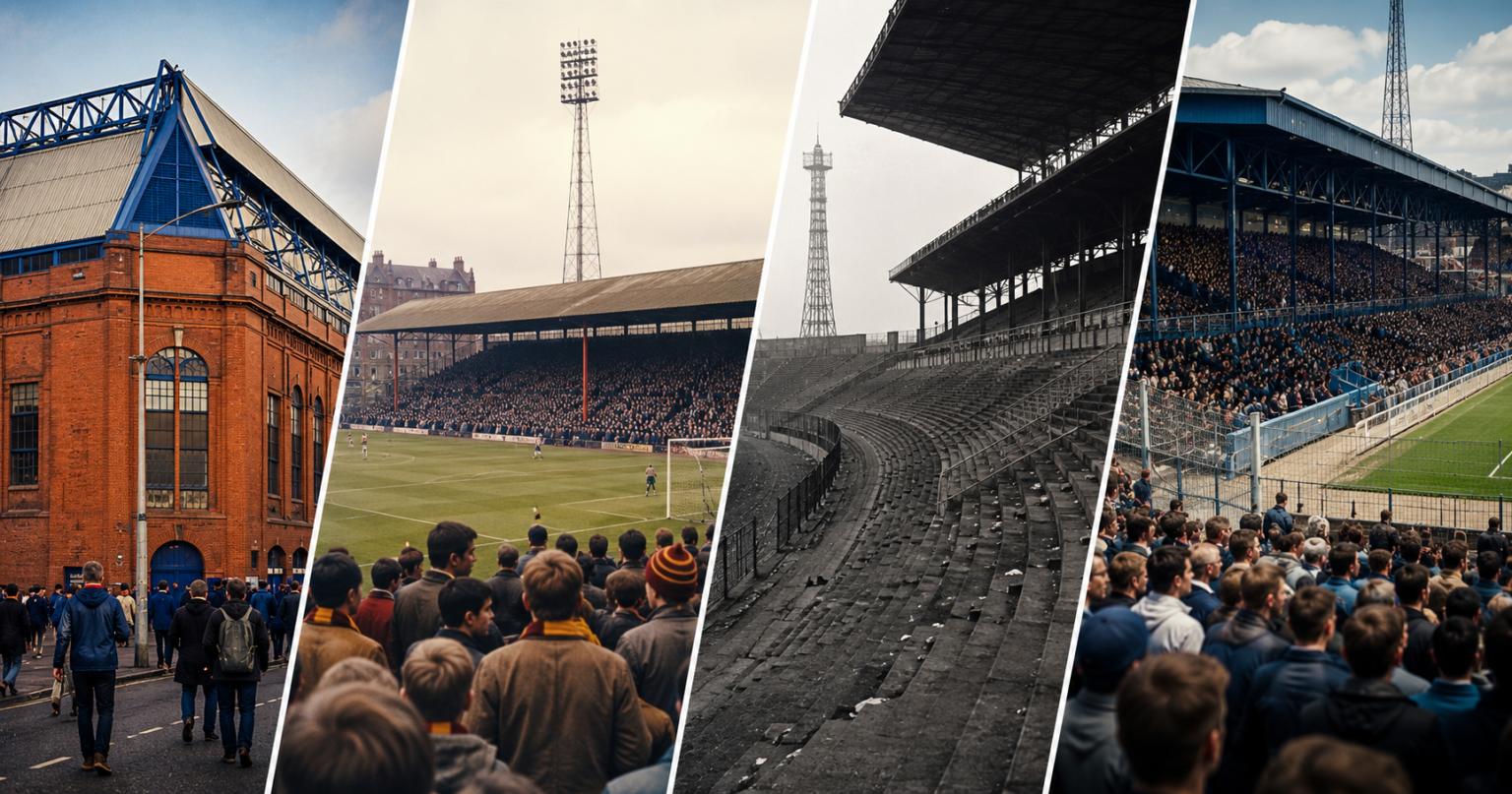
Every safety feature in a modern British football ground exists because of football stadium disaters. The seats, the exit routes, the stewarding, the licensing regime, the police control room: none of it was designed in advance. All of it was written afterwards, usually by a judge, usually after a warning that had already been given and ignored.
This is the third chapter in The Making of Modern Football. It is the least comfortable of the four, and the most important, because it explains why the game you watch today looks nothing like the game your grandparents watched. Not the tactics or the money. The building itself.
What follows deals with the reforms rather than the events in detail, and it is written with respect for those who did not come home from a football match.
The Making of Modern Football • Chapter 3
The Disasters That Forced Football to Change
Each tragedy, and the reform that followed it. 1902 to 2026.
-
1902Ibrox Park, Glasgow
Twenty-five people died when a wooden terrace collapsed during a Scotland v England match. What changed: clubs moved away from raised timber terracing towards solid earth embankments. -
1946Burnden Park, Bolton
Thirty-three people died in a crush at an FA Cup tie against Stoke City. What changed: the Moelwyn Hughes report recommended limits on crowd numbers and a licensing system. Almost none of it was acted upon. -
1958The Munich air disaster
Twenty-three people died, including eight Manchester United players, on the way home from a European Cup tie. What changed: attitudes to air travel, and the emotional place of European competition in the English game. -
1964Estadio Nacional, Lima
More than three hundred people died in the deadliest disaster in the sport’s history, at an Olympic qualifier between Peru and Argentina. -
1971Ibrox Park, Glasgow
Sixty-six people died in a crush on Stairway 13 at the end of a Rangers v Celtic match. What changed: the Wheatley Report led directly to the Safety of Sports Grounds Act 1975, the first real licensing law. -
1985Valley Parade, Bradford
Fifty-six people died when the main stand caught fire on the final day of the season. What changed: the Popplewell Inquiry brought smaller grounds into the safety legislation and ended new wooden stand construction. -
1985Heysel Stadium, Brussels
Thirty-nine people died before the European Cup final, eighteen days after Bradford. What changed: English clubs were banned from European competition for five years. -
1989Hillsborough, Sheffield
Ninety-seven Liverpool supporters died as a result of a crush at an FA Cup semi-final. What changed: everything about how British football grounds are built and policed. -
1990The Taylor Report
Lord Justice Taylor’s final report made seventy-six recommendations, the best known being all-seater stadiums in the top two divisions. -
1994The all-seater deadline
From August 1994, clubs in the top two tiers were legally required to provide seated accommodation only. The terrace disappeared from elite English football. -
2012The Hillsborough Independent Panel
The panel found that more than a hundred police statements had been amended. The original inquest verdicts were quashed by the High Court in December. -
2016The new inquests conclude
After the longest jury hearing in English legal history, the conclusion was unlawful killing. Supporters were formally found to have played no part in causing the disaster. -
2021The toll reaches ninety-seven
Andrew Devine died thirty-two years after the disaster. A coroner ruled that he too had been unlawfully killed. -
2022Standing returns, under licence
Licensed standing in rail-seated areas began at five grounds in January and opened to all eligible clubs that summer, subject to strict safety criteria. -
2026The Hillsborough Law reaches the Lords
The Public Office (Accountability) Bill passed its remaining Commons stages on 14 July 2026 and moved to the House of Lords two days later.
Disaster
Law and reform
Inquiry and accountability
Compiled by My Football Facts from official inquiry reports and parliamentary records.
The Warnings Nobody Acted On
The most uncomfortable fact in this chapter is that British football knew. It had been told, repeatedly, in writing, by people appointed to look into it.
After thirty-three people died at Burnden Park in 1946, the Moelwyn Hughes report recommended that grounds be licensed and crowd numbers limited. Nothing meaningful happened for twenty-nine years. After sixty-six people died at Ibrox in 1971, the Wheatley Report produced the Safety of Sports Grounds Act 1975, which was real progress, except that it applied only to the largest grounds. Bradford’s Valley Parade was not covered by it.
Even at Hillsborough, the specific problem was known. Crushing had occurred at the same end of the same ground at previous semi-finals. The capacity figures for the terrace had not been recalculated after alterations. The warnings existed. They were simply not treated as urgent by anyone with the power to act.
29 years
Between the Moelwyn Hughes report recommending a ground licensing system in 1946 and the Safety of Sports Grounds Act finally introducing one in 1975.
1985: Eighteen Days in May
Two disasters, eighteen days apart, ended English football’s post-war complacency for good.
On 11 May, the main stand at Valley Parade caught fire during Bradford City’s final home match of a promotion season. The structure was wooden, decades old, and had accumulated rubbish beneath the floorboards. Fifty-six people died. The Popplewell Inquiry that followed extended safety legislation down the pyramid to smaller grounds, stopped the building of new wooden stands, and changed the rules on what could be stored beneath them.
On 29 May, before the European Cup final at Heysel Stadium in Brussels, thirty-nine people died, most of them Juventus supporters, after a wall collapsed as crowds fled a charge by Liverpool fans. The stadium was in poor repair and should not have hosted the match. UEFA banned English clubs from European competition, and the ban ran for five years, with Liverpool serving a further season.
The exile mattered more than anyone expected. English clubs lost five years of European revenue, five years of competitive exposure and, arguably, a generation of tactical development, at exactly the moment Italian and Spanish football were accelerating. The record of English top flight clubs since 1888-89 has a visible gap in it, and this is where it comes from.
1989: Hillsborough and the Taylor Report
On 15 April 1989, ninety-seven Liverpool supporters died as a result of a crush in the Leppings Lane terrace at an FA Cup semi-final against Nottingham Forest. It remains the worst disaster in British sporting history.
Lord Justice Taylor’s interim report came within four months and was blunt about the causes. His final report, published in January 1990, contained seventy-six recommendations. Most concerned things spectators never notice: the calculation of terrace capacities, the design of crush barriers, the removal of perimeter fencing, communication between police control rooms and the pitch, the training and number of stewards, and the duties placed on clubs rather than on the police.
The recommendation everybody remembers is all-seater stadiums, which became a legal requirement for the top two divisions from August 1994. It is worth being precise about what Taylor actually said. He did not argue that standing was inherently unsafe. He argued that seating made crowds far easier to count, control and evacuate, and that the culture of English football grounds had to change alongside the concrete.
The Twenty-Seven Year Argument
The reforms arrived quickly. The truth did not.
In the immediate aftermath, blame was directed at Liverpool supporters, in police briefings and in parts of the press. It took until 2012, when the Hillsborough Independent Panel reported, for the scale of what had happened afterwards to become public. The panel established that more than a hundred police statements had been amended, removing or altering comments critical of South Yorkshire Police. The original inquest verdicts were quashed by the High Court that December.
New inquests ran from 2014 to 2016 and became the longest jury hearing in English legal history. On 26 April 2016 the jury concluded that the victims had been unlawfully killed and that the behaviour of supporters had played no part in causing the disaster. In 2021 Andrew Devine died from injuries sustained in 1989, and a coroner ruled that he too had been unlawfully killed, bringing the toll to ninety-seven.
Where the Hillsborough Law stands now
The Public Office (Accountability) Bill, known as the Hillsborough Law, would create a statutory duty of candour requiring public authorities and officials to tell the truth to inquiries and inquests, backed by criminal sanctions. It would also give bereaved families non-means-tested legal aid at inquests where a public authority is represented.
It was introduced in the Commons on 16 September 2025 and passed its second reading that November. Progress stalled in January 2026 in a dispute over how the duty would apply to the intelligence services, and the bill had to be carried over into the new parliamentary session in April. It passed its remaining Commons stages on 14 July 2026 and had its first reading in the House of Lords on 16 July. It is not yet law.
What Changed in the Stands
Compare a photograph of an English top flight ground in 1985 with one taken today and almost nothing is the same. The fences are gone. The terraces are gone. Capacities are lower and every one of them is calculated and licensed. Stewards outnumber police. Control rooms have camera coverage of every block.
Attendances tell their own story. English grounds are fuller now than at any point since the 1950s, in stadiums holding far fewer people, at prices that would have been unthinkable then. Safety and commercial success turned out to be the same project, which is a large part of why the Premier League could be sold as a premium television product at all. Chapter two of this series covers what happened to the money once the grounds were fit to sell.
The return of standing
The one Taylor recommendation that has been partially reversed is the ban on standing. From January 2022, five clubs were permitted licensed standing in rail-seated areas, and from that summer the option opened to every club subject to the all-seater policy, provided they meet the Sports Grounds Safety Authority’s criteria. By January 2026, thirty-nine grounds had licensed standing sections, and Wembley added ten thousand more rail seats at Level 5, used for the first time at the Carabao Cup final in March 2026.
This is not the terrace returning. Every standing spectator still has a numbered place and an independent waist-high barrier, which is precisely the distinction Taylor drew. It took thirty-three years and a licensing regime to get back to a version of something that was taken away in a fortnight.
Beyond Britain
The British reform story is the best documented, but it is not the whole picture, and the lessons have not travelled as far as they should have.
The deadliest disaster in football’s history remains the crush at the Estadio Nacional in Lima in May 1964, when more than three hundred people died at an Olympic qualifier between Peru and Argentina. More recently, one hundred and thirty-five people died at Kanjuruhan Stadium in Indonesia in October 2022, in a crush that followed the firing of tear gas into packed stands, a tactic explicitly prohibited by FIFA’s own stadium safety regulations.
Locked exits, tear gas in enclosed spaces, capacities that exist only on paper: the causes recur because the reforms are national rather than global. Britain rewrote its own rulebook in blood. Much of the world has not.
The Pattern
Across more than a century, the sequence barely varies. A risk is identified. A report recommends action. The cost or the inconvenience delays it. People die. A judge writes another report, and this time it is implemented, usually going further than the original recommendation would have.
The Hillsborough Law is an attempt to break that sequence at a different point, not by making stadiums safer but by making it harder for institutions to close ranks afterwards. Thirty-seven years on, it is still working its way through Parliament.
For more from the archive, see the all-time Premier League table and the all-time top flight table covering every season since 1888-89.
The Making of Modern Football
- 1. The Rule Changes That Rewrote Football
- 2. Follow the Money: How Football Got Rich
- 3. The Disasters That Forced Football to Change You are here
- 4. Ninety Minutes That Changed Everything Coming soon
See all four chapters in the series
Football Stadium Safety FAQs
Here are the answers to the most common questions about football’s stadium disasters and the safety reforms that followed them.
What was the Taylor Report?
The public inquiry into the Hillsborough disaster, led by Lord Justice Taylor. His interim report appeared in August 1989 and his final report in January 1990, containing seventy-six recommendations. These covered terrace capacity calculations, crush barriers, perimeter fencing, stewarding, police communications and club responsibilities. The best known recommendation led to all-seater stadiums in the top two divisions of English football.
When did English football stadiums become all-seater?
From August 1994. Clubs in the Premier League and the second tier were legally required to provide seated accommodation only, following the Taylor Report. The requirement applies to clubs that have spent at least three seasons in the top two divisions since 1994-95.
How many people died at Hillsborough?
Ninety-seven. Ninety-four supporters died on 15 April 1989 or shortly afterwards, with the toll later rising as two more victims died from their injuries. Andrew Devine became the ninety-seventh in 2021, thirty-two years after the disaster, when a coroner ruled that he had also been unlawfully killed.
Why were English clubs banned from European football?
Following the Heysel Stadium disaster on 29 May 1985, when thirty-nine people died before the European Cup final between Liverpool and Juventus in Brussels. UEFA banned English clubs from European competition, and the ban lasted five years, with Liverpool serving an additional season.
Is safe standing allowed at football grounds now?
Yes, under licence. Licensed standing in rail-seated areas began at five grounds in January 2022 and opened to all clubs subject to the all-seater policy that summer. Clubs must meet Sports Grounds Safety Authority criteria covering stewarding, camera coverage and seat design. By January 2026 there were thirty-nine grounds with licensed standing sections.
What is the Hillsborough Law?
The Public Office (Accountability) Bill, which would impose a statutory duty of candour on public authorities and officials during inquiries and inquests, backed by criminal sanctions, and provide non-means-tested legal aid to bereaved families. It was introduced in September 2025, passed its remaining Commons stages on 14 July 2026 and is currently before the House of Lords.
What was the worst disaster in football history?
The crush at the Estadio Nacional in Lima in May 1964, during an Olympic qualifying match between Peru and Argentina, in which more than three hundred people died. It remains the deadliest incident at a football match anywhere in the world.