
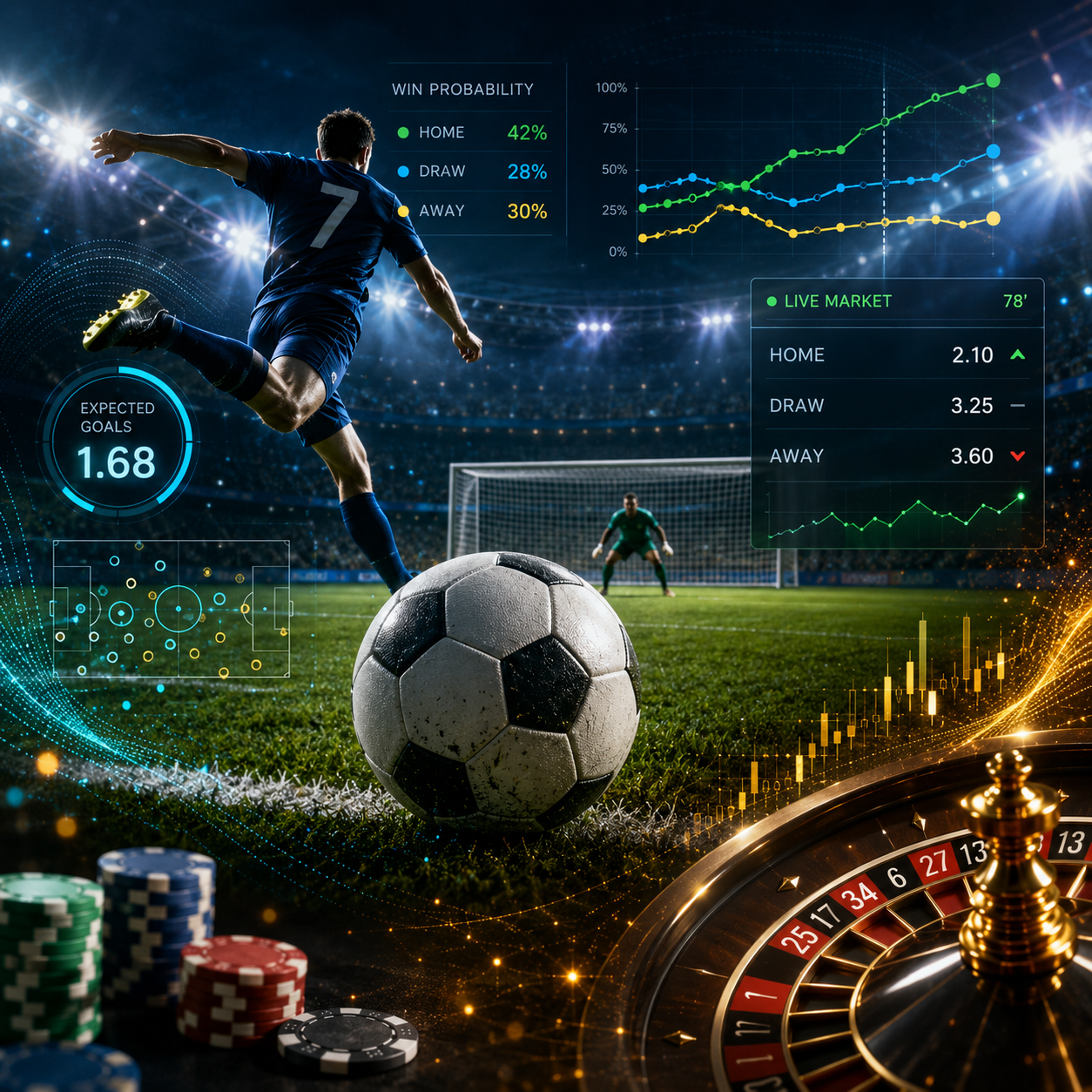

Football has always been a sport that lives on the edge of unpredictability. A single deflection, a moment of hesitation, a burst of individual brilliance—any of these can redraw the entire story of a match. That fragile balance between order and chaos is precisely what makes the game so compelling, and it is also what draws it naturally into the orbit of online betting and casino platforms.
In today’s digital environment, football is no longer just watched; it is interacted with. Fans do not simply observe ninety minutes—they engage with fluctuating odds, live markets, and data-rich betting interfaces that evolve alongside the match itself. For many readers exploring this landscape, resources like Casinority gambling guides often help decode the underlying logic of odds, risk, and decision-making that now sits beside the sport.
What we are witnessing is not a passing trend, but a structural transformation in how sport is consumed and monetised.
Football’s unique power in the betting world
There is a reason football dominates global betting activity more than any other sport. It is not just popularity—it is structural suitability.
Football matches are low-scoring, time-bound, and statistically rich. That combination creates a fertile ground for probability-based interpretation. Unlike sports where scoring is constant and outcomes swing widely, football often hinges on narrow margins that can be meaningfully analysed.
A few key drivers explain its dominance:
- Global accessibility: From domestic leagues in Europe to international tournaments, football offers a near-constant calendar of events.
- Predictable unpredictability: Outcomes are uncertain, but patterns—form, tactics, injuries—matter significantly.
- Data saturation: Modern football generates enormous datasets, from expected goals (xG) to pressing efficiency and possession structures.
- Emotional attachment: Fans rarely engage as neutral observers, which intensifies participation in betting markets.
The result is a sport that feels simultaneously knowable and unknowable—a perfect paradox for wagering systems.
The explosion of live betting culture
If traditional betting was about predicting the future, modern football wagering is about reacting to the present.
In-play betting has become the dominant form of engagement across many platforms. Industry data suggests that more than half of all sports wagers are now placed after matches have already started, a shift that has fundamentally altered user behaviour.
Live betting turns football into a dynamic, second-by-second market. Every on-field action recalibrates probability:
- A red card reshapes the match equilibrium instantly.
- A missed penalty can swing win probabilities dramatically.
- Tactical substitutions often shift momentum expectations within minutes.
This creates a hybrid experience that sits somewhere between sports viewing and real-time strategic decision-making. It is no longer passive consumption; it is continuous interaction.
And with that shift comes intensity. Watching football while engaging with live markets adds a psychological layer that traditional viewing never had.
Where online casinos enter the picture
Modern online casinos are no longer separate from sports betting environments. Instead, they are integrated ecosystems designed to keep users within a single platform for extended periods.
Football betting typically serves as the entry point. Casino games often serve as the continuation.
This integration is deliberate and highly structured:
- Football matches generate peak traffic spikes.
- Casino games maintain engagement between fixtures.
- Cross-promotional systems link both activities through bonuses and incentives.
In practice, this means a user might watch a Champions League match, place live wagers during it, and then transition into casino games once the match ends—all within the same platform environment.
The boundaries between sports betting and casino gaming have become functionally blurred.
The psychological engine behind football wagering
At its core, betting on football is rarely purely analytical. Even highly experienced users operate within a mixture of logic and emotional bias.
Three psychological forces dominate this space:
- Emotional proximity. Fans consistently overestimate teams they support or follow closely. Familiarity creates confidence, even when data suggests otherwise.
- Pattern illusion. A few consecutive results often feel like a trend, even when statistically insignificant.
- Control bias. Tactical understanding of football creates the illusion that outcomes are more predictable than they actually are.
These cognitive tendencies are not flaws in thinking—they are natural human responses to a highly emotional sport. But in a betting environment, they can distort decision-making unless consciously managed.
The datafication of football markets
Behind every odds movement lies a sophisticated data engine. Bookmakers no longer rely on intuition; they rely on continuous statistical modelling.
Modern pricing systems typically incorporate:
- Historical performance metrics
- Player-level availability and injury data
- Tactical formations and style matchups
- Weather, venue, and travel conditions
- Real-time betting volume and market pressure
These systems are increasingly powered by machine learning models that adjust probabilities dynamically, especially in live environments. The result is a market that behaves less like a static prediction system and more like a continuously updating financial model.
Yet even with this sophistication, inefficiencies still exist—particularly in lower-tier leagues or niche competitions where data depth is weaker. Skilled analysts sometimes identify these gaps, although consistency remains extremely difficult to achieve.
The blurring line between sport and financial behaviour
One of the most striking developments in 2026 is how closely football betting resembles financial trading in its structure and psychology.
Live markets fluctuate like micro-exchanges. Odds shift based on liquidity, sentiment, and sudden information changes. Users react in real time, often with split-second decisions.
This resemblance is not accidental. Both systems rely on probability, risk tolerance, and behavioural interpretation of incomplete information.
However, there is a crucial difference: football retains emotional identity. Unlike financial markets, decisions are often influenced by loyalty, memory, and cultural attachment.
That emotional layer makes the ecosystem both more engaging and more volatile.
Responsible engagement in a high-intensity environment
With increased integration comes increased need for discipline. Football betting and casino environments are designed for engagement, not restraint, which makes self-regulation essential.
Sustainable engagement typically relies on a few principles:
- Treating betting as entertainment, not income generation
- Setting strict time and budget boundaries before engagement begins
- Avoiding emotionally driven decisions during live matches
- Separating analytical insight from fan loyalty
The most experienced participants in this space are not those who “guess correctly” most often, but those who manage exposure most effectively.
A unified digital experience
Football and online casinos are no longer separate ecosystems. They are intertwined systems of entertainment, data interpretation, and behavioural engagement.
Football provides narrative tension—the story, the emotion, the unpredictability that keeps millions watching. Online casino platforms and betting systems provide structure—the mathematical frameworks, the real-time markets, and the digital infrastructure that transforms watching into interaction.
Together, they form a modern hybrid experience: part sport, part analytics, part interactive entertainment.
And while the final whistle still ends the match, in the digital world, it no longer ends the engagement. It simply shifts the stage.