



Hosting a FIFA World Cup is one of the most prestigious projects a country can undertake. As a World Cup host economic impact is undoubtedly a very expensive undertaking. From new stadiums to upgraded transport networks, the bills run into billions, and the economic case for hosting is fiercely debated among economists. So what does it really cost, and what do host nations actually get back?
The Headline Numbers
Qatar 2022 reset the entire conversation. The Gulf nation reportedly spent in excess of $220 billion on infrastructure, stadiums, and tournament delivery. By far the highest figure in history. By contrast, Russia 2018 came in at around $14 billion, Brazil 2014 at $15 billion, and South Africa 2010 at roughly $4 billion. Even adjusting for inflation, Qatar’s spend was an order of magnitude beyond every previous host.
What’s Included in the Cost?
Direct tournament costs, things like stadiums, training grounds, and FIFA payments, typically account for only 20 to 40 percent of the total. The rest is infrastructure: airports, metro lines, hotels, roads, telecoms. Qatar built an entirely new city, Lusail, to house the final. Brazil built or renovated 12 stadiums, several of which now sit underused. Russia constructed seven new venues. Hosting becomes a national modernisation project as much as a football tournament.
Tourism and Short-Term Boost
Host nations consistently see a tourism spike during the tournament itself. Qatar welcomed approximately 1.4 million visitors, Russia hosted around 3 million, Brazil more than 1 million. Hotels run at near-100% occupancy, hospitality and retail revenues climb, and broadcast exposure delivers months of free advertising for the host country’s brand. The South African government estimated a $4-6 billion direct tourism contribution from 2010.
The Long-Term Picture
This is where the case for hosting becomes much harder to make. Most economists who have studied prior tournaments conclude that the long-term economic return rarely justifies the spend. Stadiums become “white elephants”. Manaus in Brazil, several Qatari venues, parts of South Africa’s 2010 stock all sit half-empty year-round. Infrastructure built specifically for the tournament can deliver lasting value (Germany’s high-speed rail upgrades for 2006 are the textbook example), but only when it serves genuine pre-existing needs.
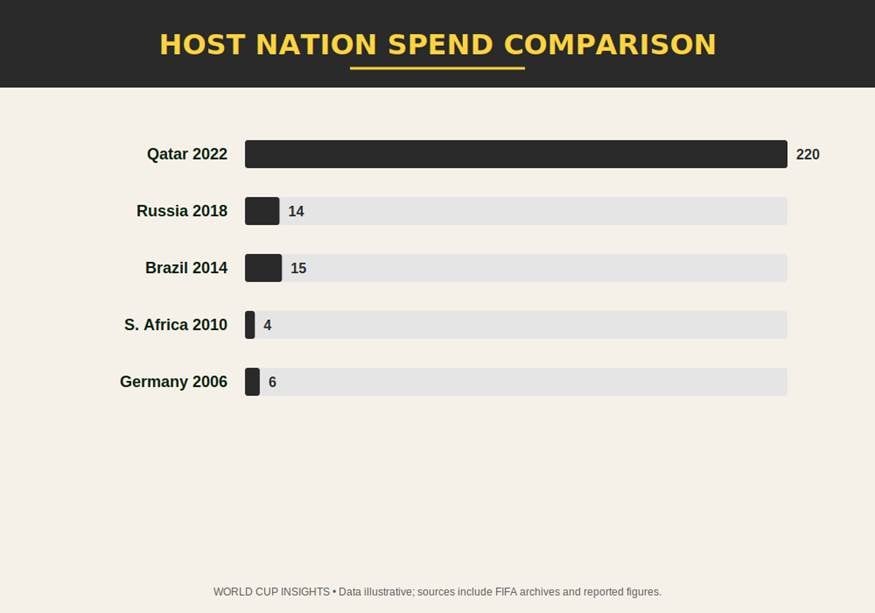
Infographic: Host Nation Spend Comparison infographic
Soft Power and National Brand
The real return on a World Cup may be intangible. Hosting projects an image of competence, modernity, and global relevance. Qatar used the tournament to introduce itself to billions of viewers who would otherwise know little about it. South Africa’s hosting in 2010 helped shift the post-apartheid narrative. Russia 2018 was widely judged a logistical success that improved the country’s international image (briefly, in that case). Whether soft power is worth tens of billions depends entirely on whom you ask.
The 2026 Model: Sharing the Burden
The 2026 hosts, USA, Canada, and Mexico, represent a deliberate departure from the megaspend approach. The tournament will use existing NFL and major league stadiums almost exclusively, requiring no significant new builds. The total cost is projected at around $10 billion, with FIFA expected to take in record revenues of approximately $11 billion. For the first time, the math may simply work.
What 2030 and 2034 Tell Us
The 2030 tournament will be split across six nations on three continents. Spain, Portugal, Morocco, plus single matches in Uruguay, Argentina, and Paraguay. Distributing costs makes sense in principle but raises logistical questions. Saudi Arabia’s 2034 hosting, by contrast, signals a return to the megaspend model. Multiple new stadiums, a futuristic host city (Neom), and projected costs that may rival or exceed Qatar’s.
Lessons from Past Hosts
Patterns emerge across decades. Stadium overbuilding consistently destroys value: cities are persuaded to build venues they don’t need. Infrastructure that doubles as long-term public utility (rail, airport, metro) generally pays back. Direct tournament-period revenue is real but limited. Typically $3-5 billion across hospitality, broadcast, and merchandising. The strongest case for hosting is when a nation is genuinely modernising and the World Cup serves as deadline and showcase. The weakest case is when it’s done primarily for prestige. The 2030 multi-host model may resolve some of these tensions. The 2034 megaspend model will test them again.
The Bottom Line
Hosting a World Cup makes financial sense only when it aligns with broader development goals. As a standalone investment, the numbers rarely work. As a national milestone, a soft-power exercise, or a deadline for long-overdue modernisation, it can deliver lasting value. Future hosts would do well to study the lessons carefully.
Conclusion
There is no single answer to whether hosting a World Cup is “worth it”. For developed nations using existing infrastructure, it can break even or turn a modest profit. For developing nations building from scratch, it almost always loses money. But it may deliver longer-term gains that resist easy measurement.