




The football played at the 1930 World Cup would be barely recognisable to a modern viewer. Five forwards, two half-backs, no substitutes, no offside as we understand it, and certainly no high press. The World Cup tactical evolution has changed beyond recognition. And the World Cup, as football’s biggest stage, has been both the showcase and the catalyst for tactical evolution.
- The Pyramid Era: 2-3-5 and the WM
- 4-2-4 and Brazilian Innovation (1958)
- Total Football (1974)
- Italian Catenaccio and the Defensive Era (1980s-90s)
- The 4-4-2 Workhorse (1990s)
- Tiki-Taka and the Spanish Revolution (2008-2012)
- Pressing, Verticality, and the Modern Era (2014 onwards)
- What’s Next?
- How Coaching Has Adapted
- Where Tactics Go Next
- Conclusion
The Pyramid Era: 2-3-5 and the WM
Early World Cups were dominated by the 2-3-5 formation. Two defenders, three half-backs, five forwards. It produced the high-scoring matches typical of the era, with goal averages above 4 per game in 1930 and 1934. By the late 1930s, Arsenal manager Herbert Chapman’s WM formation (3-2-2-3) was spreading, pulling a centre-half into defence and creating the first recognisable back three. Italy’s 1934 and 1938 titles came using variations of this system.
4-2-4 and Brazilian Innovation (1958)
The biggest tactical leap of the post-war era came from Brazil. Their 4-2-4 system at Sweden 1958 introduced a true back four and unleashed two genuine wingers alongside Pelé and Vavá. It produced football no one had quite seen before. Fluid, attacking, and devastatingly effective. Within a decade, the 4-2-4 had become the default global formation.
Total Football (1974)
The Netherlands at West Germany 1974 brought Total Football to the global stage. Pioneered by Rinus Michels and embodied by Johan Cruyff, the system asked every outfield player to be capable of playing any role. Positional fluidity, intense pressing, and a high defensive line redefined what a football team could look like. The Dutch lost the final, but their influence persisted for decades.
Italian Catenaccio and the Defensive Era (1980s-90s)
While the Dutch were pushing forward, Italy refined the opposite extreme. Catenaccio, “the chain”, locked teams down with a sweeper behind a man-marking back four. The 1982 World Cup-winning Italian side was its apex. Throughout the 80s and 90s, defensive solidity became the dominant World Cup philosophy, with goal-per-game averages dropping below 2.5 for the first time in tournament history.
The 4-4-2 Workhorse (1990s)
By the 1990s, the 4-4-2 was the world’s default formation. Two banks of four, two strikers, hard work and discipline. Germany used it to win in 1990, Brazil with 4-2-2-2 variants in 1994 and 2002. It dominated club and international football for fifteen years, prized for its balance and simplicity. Its limitations would only become apparent when something better arrived.
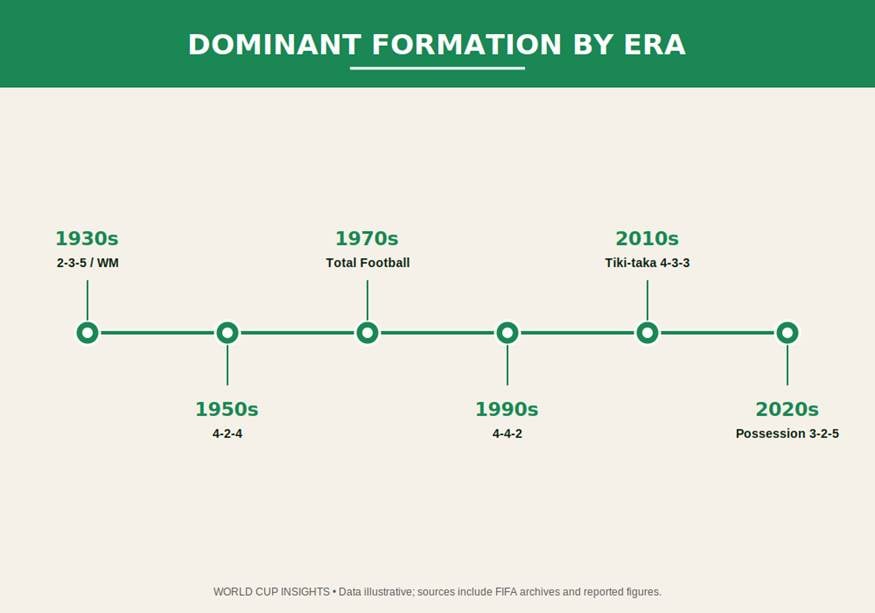
Infographic: Dominant Formation by Era infographic
Tiki-Taka and the Spanish Revolution (2008-2012)
Spain’s golden generation, drawing on Barcelona’s La Masia philosophy, perfected tiki-taka. Short passing, positional rotation, and aggressive ball recovery. They won Euro 2008, the 2010 World Cup, and Euro 2012. The first international treble in history. The 4-3-3 became the new template, and possession became football’s new orthodoxy. Even teams without Spain’s technical quality copied the broad principles.
Pressing, Verticality, and the Modern Era (2014 onwards)
Germany’s 2014 victory introduced gegenpressing to the World Cup audience. By 2018, France won with a more pragmatic counter-attacking blueprint. Argentina’s 2022 title combined Lionel Scaloni‘s flexibility with Lionel Messi’s brilliance. Today’s tactical default is a possession-based 4-3-3 or 3-2-5 in build-up, with aggressive pressing out of possession. Goalkeepers play as auxiliary defenders. Full-backs invert. Tactics have become more sophisticated, more positionally defined, and more demanding than ever before.
What’s Next?
Set-piece coaches, data scientists, and individual player profilers are now standard at elite international setups. Expect 2026 to feature more positional flexibility, more in-game tactical switches, and continued experimentation with build-up shapes. The tactical arms race shows no sign of slowing. And the World Cup, as ever, will be where the latest ideas meet the highest stakes.
How Coaching Has Adapted
Coaching itself has transformed. Modern World Cup managers arrive at the tournament with full analytics departments, set-piece specialists, and detailed scouting dossiers on opponents. Pre-tournament training camps now include data scientists alongside fitness coaches. Substitutes are deployed earlier and more tactically. The notion of an immutable starting XI is largely gone. Top sides rotate aggressively across the group stage. The 2026 expansion will require even more sophisticated rotation, and managers comfortable making sweeping changes between matches will hold a structural advantage.
Where Tactics Go Next
Goalkeepers as auxiliary defenders, inverted full-backs as midfielders, and three-centre-back builds with two as ball-carriers. The modern game’s tactical complexity continues to rise. The 2026 World Cup will be the first major test of whether national teams, with limited training time, can keep pace with the club-level innovations now standard at top European sides.
Conclusion
From 2-3-5 to 3-2-5, football has come almost full circle in some ways. And travelled an enormous distance in others. The World Cup remains tactics’ most public laboratory.