

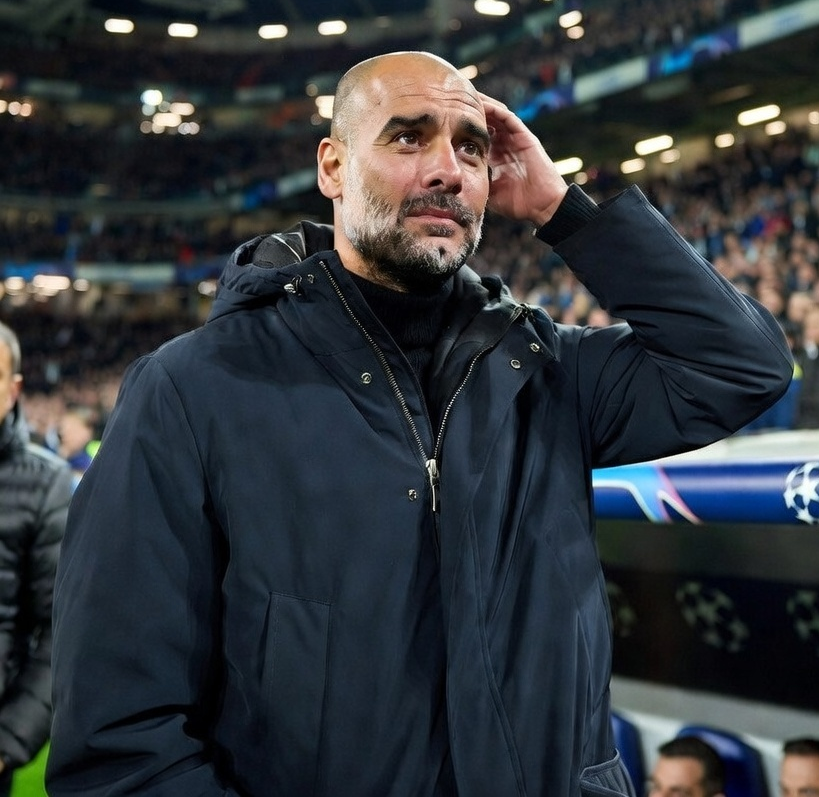
When Pep Guardiola took charge of Manchester City in 2016, the unspoken promise was clear: Europe’s grandest prize would follow. A decade on, with City crashing out of the Champions League at the last-16 stage following a humiliating 5-1 aggregate defeat to Real Madrid, the football world is beginning to ask whether the greatest manager of his generation has left his most coveted ambition unfulfilled.
The numbers, on the surface, remain impressive. Three Champions League titles — two with Barcelona in 2009 and 2011, one with City in 2023 — place Guardiola among the competition’s most decorated managers. Only Carlo Ancelotti, with five, has won it more. Yet it is the weight of what has not been achieved that lingers, and no opponent has contributed to that feeling more than Real Madrid.
The Madrid Curse
Guardiola’s 50th encounter with Real Madrid — which he dubbed his ‘birthday fixture’ ahead of the first leg at the Bernabeu — ended in anything but celebration. City were dismantled 3-0 in Spain, and although they pushed in the second leg at the Etihad, Bernardo Silva’s early red card extinguished any flickering hope of a famous comeback.
It was a familiar story. Since City’s Champions League final defeat to Chelsea in 2021, Real Madrid have been the sole architects of their European downfall every single time. Guardiola has now been eliminated from the Champions League by Los Blancos five times — once with Bayern Munich and four times with City — accumulating seven defeats against them in the competition alone, more than any other manager in history.
The litany of near-misses reads like a tragedy in instalments. A Raheem Sterling goal cruelly ruled out by VAR against Tottenham in 2019. A quarter-final exit against Lyon in 2020. The gut-wrenching penalty shootout defeat at the Etihad in the 2023-24 last eight. And always, looming behind every misfortune, the shadow of the Bernabeu.
“I think the defensive part of his game could be improved, but I don’t think he’s going to change.” — Clarence Seedorf said on Amazon Prime
A Philosophy Under Scrutiny
Four-time Champions League winner Clarence Seedorf offered a measured but pointed verdict. There is no question about Guardiola’s quality, Seedorf argued, but his relentlessly attacking philosophy — built on domination, positional play and outscoring opponents — carries an inherent vulnerability when facing the elite at the business end of the competition. And his defensive setup, Seedorf observed bluntly, is unlikely to change.
It is a critique that has followed Guardiola throughout his managerial career. His Barcelona sides were so overwhelmingly dominant that the question was rarely asked. But at Bayern Munich, despite three successive Bundesliga titles, European glory eluded him entirely in three attempts, with two semi-final exits to Real Madrid among the most painful. It was only at City, after years of agonising near-misses, that he finally lifted the trophy again — in Istanbul in 2023, as part of a historic Treble.
Yet the intervening period has told a sobering story. Since that night in Istanbul, City have won only a single Champions League knockout tie — against Copenhagen — and have lost nine of their past 17 European matches.
A Club in Transition
Context, of course, matters. Fifteen of the 23 players who featured in the 2023 Champions League final are no longer at the club. A trophyless 2024-25 campaign — Guardiola’s first without silverware since his debut season at City — was attributed to a combination of injury misfortune and a squad still integrating new faces.
The manager himself struck a defiant note after Tuesday’s exit. “We have an extraordinary team and extraordinary group of players,” he said. “The future is bright.” But the words carried the unmistakable ring of a man searching for conviction in a difficult moment.
City’s season is not yet over. They trail Arsenal by nine points in the Premier League title race, though with a game in hand and a direct fixture against the Gunners still to come. Sunday’s Carabao Cup final against their north London rivals presents an immediate opportunity for redemption, and they remain alive in the FA Cup. Guardiola, characteristically, will not allow the narrative to be written for him.
The Uncertain Future
What hangs most heavily over this exit, however, is what it may represent. Guardiola’s current contract runs until the end of next season, and there are credible reports that he may choose to step away at the conclusion of this, his tenth year in Manchester. If so, this defeat to Real Madrid could well mark the final chapter of his Champions League story as City manager.
That would mean four attempts to add to his 2023 triumph at City — and four failures. In the coldest possible light, that is a return that falls below the bar Guardiola himself has always set. He has managed more matches in the quarter-finals and beyond of the Champions League than any other manager since his debut season. Yet of those deep runs, only one has ended in glory.
Three Champions League titles is a legacy that would satisfy almost any manager on the planet. But Guardiola is not almost any manager. He has always appeared to regard Europe’s elite club competition as the ultimate arbiter of greatness — the one competition that separates the merely brilliant from the truly immortal. By his own exacting standards, the record asks uncomfortable questions.
The cruel irony is that the competition has given him both his defining peaks and his deepest wounds. As he stares down the prospect of another season without Champions League silverware, the question is not whether Pep Guardiola is one of football’s greatest ever managers. He is. The question is whether, when the final audit is drawn, the competition he covets most will have delivered the full measure of what he deserved.