

Few sporting events command the global attention of the FIFA World Cup. Every four years, billions of viewers tune in as 32 nations (soon to be 48) chase football’s most coveted prize. But the tournament we know today is the product of a long, often turbulent history. It spans nearly a century, two world wars, dramatic format changes, and the rise of football as the planet’s true universal language.
The Birth of a Global Tournament (1930)
The inaugural FIFA World Cup was held in Uruguay in 1930, championed by FIFA president Jules Rimet. Only thirteen nations took part, and several European sides refused to make the long boat journey across the Atlantic. Uruguay, then a footballing powerhouse fresh off two Olympic golds, were rewarded with both home advantage and the first trophy. They defeated Argentina 4-2 in the final at the Estadio Centenario in Montevideo. It set a template of drama, controversy, and national pride that has defined every tournament since.
Pre-War Italy and Post-War Revival (1934-1950)
Italy hosted in 1934 and won on home soil, then retained the trophy in France 1938 under the legendary coach Vittorio Pozzo. He remains the only manager ever to win back-to-back World Cups. The Second World War then forced a twelve-year hiatus. When the tournament returned in Brazil in 1950, it produced one of football’s most painful moments. In the so-called “Maracanazo”, Uruguay shocked the hosts 2-1 in the deciding match. The result still haunts Brazilian football folklore.
The Pelé Era and Brazilian Dominance (1958-1970)
If any single nation defined the World Cup’s first golden age, it was Brazil. A 17-year-old Pelé burst onto the scene in Sweden 1958, scoring a hat-trick in the semi-final and twice in the final. Brazil won again in Chile 1962. In a rare interruption to their grip on the trophy, the 1966 tournament belonged to the hosts, as England won the World Cup for the only time in their history. Geoff Hurst scored a hat-trick in the final, still the only player ever to do so, as England beat West Germany 4-2 after extra time at Wembley, with captain Bobby Moore lifting the trophy under manager Alf Ramsey. Brazil then returned to produce what many consider the greatest team in history at Mexico 1970. Their 4-1 win over Italy in the final was captured in vivid colour for the first time on global television. Brazil were also handed the original Jules Rimet Trophy to keep, having become the first three-time winners.
Modern Expansion and European Power (1974-1998)
From 1974 onwards, the tournament expanded steadily. The trophy was redesigned, West Germany hosted and won, and the Dutch “Total Football” revolution reshaped tactics forever. Argentina won in 1978 and again in 1986, the latter inseparable from Diego Maradona’s brilliance and controversy. Italy claimed a third star in 1982, Germany a third in 1990, and France lifted their first trophy on home soil in 1998. The tournament had become the world’s biggest single-sport event.
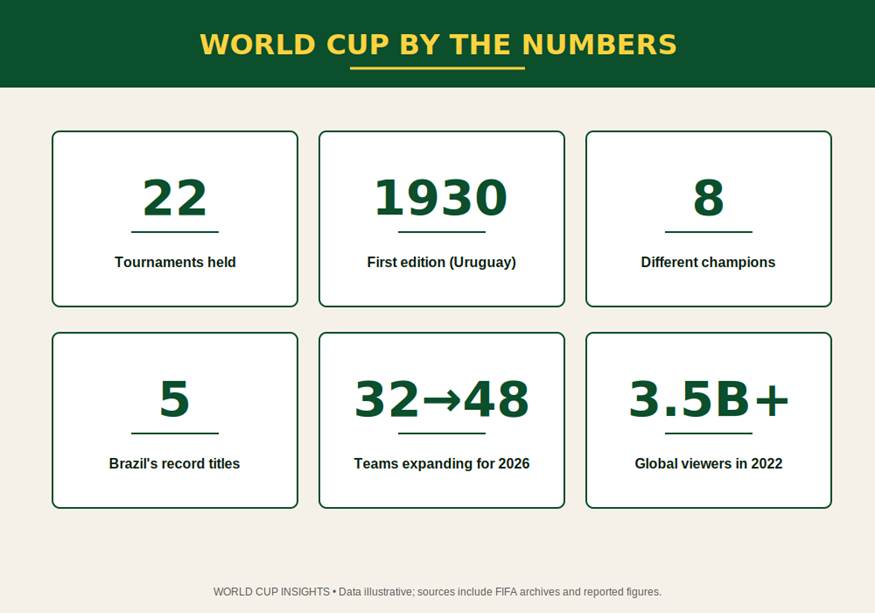
Infographic: World Cup By The Numbers infographic
The 21st Century: Globalisation and Spectacle (2002-2022)
The 21st century brought the tournament to new continents. South Korea and Japan co-hosted in 2002, South Africa staged the first World Cup on African soil in 2010, and Qatar became the first Arab host in 2022. The football itself evolved too. Spain perfected tiki-taka to win in 2010, Germany dismantled Brazil 7-1 in 2014, and Argentina edged France in a thrilling penalty shootout in Doha to crown Lionel Messi’s career at last. With viewing audiences continuing to climb past 3.5 billion, the World Cup has cemented itself as a truly planetary event.
Looking Ahead
The next chapter is already being written. In 2026, the tournament expands to 48 teams across the USA, Canada, and Mexico. In 2030, a six-nation centenary edition will span three continents. The format keeps changing, the prize money keeps growing, and the sheer scale keeps expanding. But the essential drama remains. With every World Cup, new heroes are made, old rivalries reignited, and football’s place at the centre of global culture confirmed once more.
The World Cup’s Cultural Footprint
Beyond the football itself, the World Cup has become an immense cultural phenomenon. Its songs, from Shakira’s “Waka Waka” to Ricky Martin’s “La Copa de la Vida”, have topped global charts. Brands have built entire marketing calendars around the four-year cycle. Schools across the world adjust their schedules during the tournament. National flags appear on cars, balconies, and faces in countries that may not have produced a single match-winning moment. The tournament’s grip on popular culture has only grown alongside its sporting profile, and that combination of sport and spectacle is precisely what makes it irreplaceable. Even those who never watch club football tune in for a World Cup. A feat no other sporting event matches at the same scale.
Key Takeaways
The FIFA World Cup has grown from a 13-team experiment into the world’s most-watched single sporting event. The trophy has been claimed by just eight different nations, but the chase has involved every footballing culture on the planet. As 2026 approaches, the tournament’s history offers a vital reminder. Every great moment that came before was, in its time, brand new. The next chapter is ours to watch unfold.
Conclusion
From Montevideo 1930 to whatever comes next, the World Cup remains the ultimate test of footballing nations. Its history is, in many ways, the history of the modern game itself.

About the author: Ben Jardine
Ben Jardine is the managing editor of My Football Facts and has covered football since 2014. He writes across football statistics, history and current affairs, from all-time records and World Cup deep dives to live transfer-window coverage, with a focus on rigorously fact-checked, data-led analysis. Connect with Ben on LinkedIn.