
From Uruguay in 1930 to the massive North American spectacle planned for 2026 World Cup, the World Cup hosts history tells the story of how football’s biggest tournament has grown into a truly global event. Over the decades, different World Cup host countries have shaped the competition in unique ways, from iconic stadiums and unforgettable finals to cultural moments that defined generations of fans.
The upcoming tournament will break new ground as the 2026 World Cup three hosts — the United States, Canada and Mexico — combine to stage the first ever 48-team edition and the largest tournament football has ever seen. This new era of World Cup co-hosting represents a major shift in FIFA’s approach and adds another fascinating chapter to the history of World Cup hosts. With more matches, more cities and more fans than ever before, the 2026 tournament is already being described as the biggest World Cup ever.
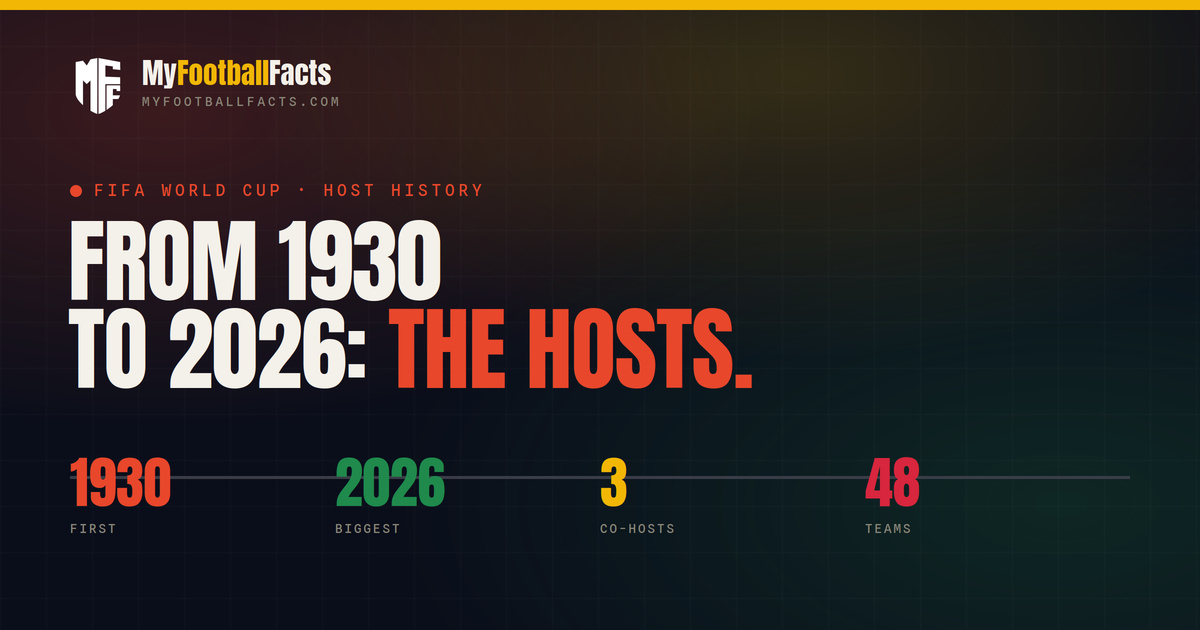
World Cup Hosts Through History, 2026 Compared — From 1930
To 2026:
The Hosts.
From a 13-team gathering in 1930 to a three-nation, 48-team spectacle in 2026 — here is how World Cup hosting has evolved, and why 2026 breaks every mould.
World Cup Hosts Through History — And How 2026 Compares
Since 1930, the World Cup has visited every populated continent and grown from a modest 13-team gathering into a global spectacle. The 2026 edition rewrites the record books again — the first three-nation tournament and by far the largest ever. Here is how it fits into the long story of World Cup hosting.
The Growth Of The World Cup
Fig. 01 — Teams By Era
1930 Uruguay131950s–70s161982–1994241998–2022322026 (USA/MEX/CAN)48
Number of finalists has expanded steadily across eras, culminating in 48 for 2026.
The early years and a single host
For most of its history, the World Cup was hosted by one nation. Uruguay staged the inaugural 1930 tournament with 13 teams; through the following decades, hosting passed between Europe and the Americas, with the field gradually widening to 16 and then 24 teams.
The era of co-hosting
Shared hosting is rarer. The 2002 tournament in South Korea and Japan was the first to span two nations — a landmark in spreading the game to new regions. The 2026 World Cup goes a step further as the first ever hosted by three countries, uniting the USA, Mexico and Canada.
How 2026 breaks the mould
- First three-nation host — no previous World Cup has been shared by three countries.
- Largest field ever — 48 teams, up from 32, and 104 matches in all.
- Most venues — 16 host cities, more than any prior edition.
- A returning giant — Mexico’s Estadio Azteca becomes the first stadium to host three World Cup opening matches.
What it means for the future
2026 is a statement about where the World Cup is heading: bigger, more inclusive, and increasingly shared across borders. The blueprint of multiple co-hosts pooling stadiums and infrastructure may well shape how future tournaments are awarded — making this edition not just the largest, but potentially a turning point in how the World Cup is staged.
More on the 2026 World Cup
Don’t Miss Out
Be There In 2026
The biggest World Cup in history is just around the corner. Secure your seats for the matches that matter before they sell out.