







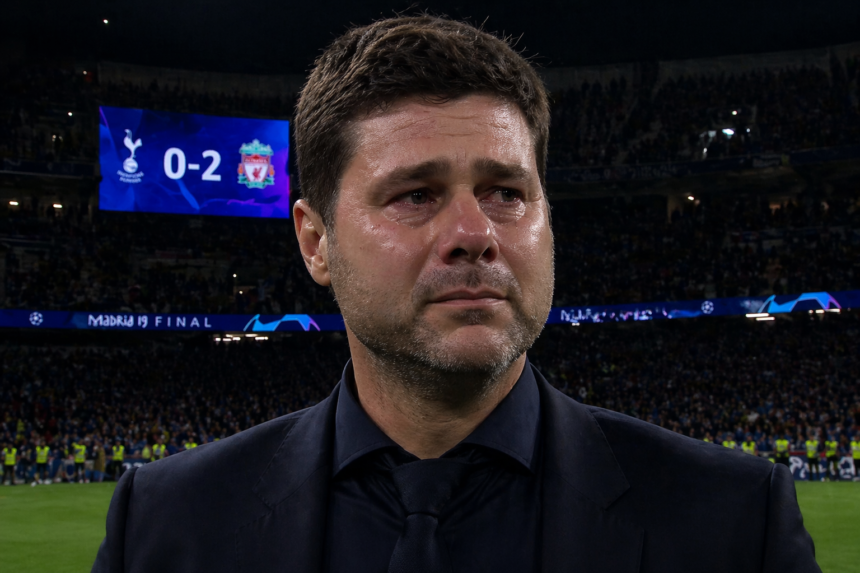
And then Pochettino did what every manager in his position would have been tempted to do. He started Harry Kane.
Kane had been out since early April with an ankle ligament injury and had played no part in the knockout rounds. Lucas, meanwhile, had just authored the most extraordinary 30 minutes in the club’s modern history. He was sharp, fearless, already inside Liverpool’s heads. The sentimental pick — and the narrative pick — was the captain returning in time to lift the trophy. The logical pick, the one the semi-final itself had screamed for, was Lucas.
Pochettino went with sentiment. Kane looked what he was: a player who hadn’t kicked a ball in two months. Liverpool scored inside 30 seconds from a handball and controlled the rest. Spurs lost 2-0. Lucas came on for the last half hour and couldn’t rescue it.
You can argue this call either way. Plenty still do. But it is the clean dividing line in the modern story of Tottenham Hotspur — the last moment at which the club was taken seriously as a genuine force at the summit of English football. Everything since has been a negotiation with that failure.
The Pochettino sacking — the original sin
Fewer than six months after that final, in November 2019, chairman Daniel Levy sacked Pochettino. Spurs were 14th in the table. The squad, long under-invested in, had stopped responding. The argument for change had a patina of reasonableness.
It was still the original sin.
Pochettino had built the club brick by brick over five and a half years — a coherent identity, a recruitment model, an academy pipeline (Kane, Harry Winks, Oliver Skipp), and European credibility. You do not replace that. You renew it. Levy replaced it. And the man he replaced it with, appointed within 12 hours, was José Mourinho — a coach whose entire philosophy was the inverse of Pochettino’s and whose playing style, by 2019, was already visibly out of time.
That reflex — when in doubt, reach for the biggest name on the market and hope reputation substitutes for fit — is the boardroom tic that has defined Tottenham ever since. The Argentine manager has stated his overwhelming desire to one day return to Tottenham as a manager for a second stint.
A carousel of famous names
What has followed, in the six and a half years since Pochettino’s departure, reads less like a succession plan than a hostage video of English football’s managerial class.
Mourinho lasted until April 2021, sacked six days before a League Cup final. Ryan Mason, a 29-year-old academy coach, took the final. They lost. Nuno Espírito Santo was appointed that summer after a months-long, publicly humiliating search in which several higher-profile candidates said no; he was gone by November. Antonio Conte replaced him and imploded in a now-legendary press conference in March 2023 in which he called his own players “selfish.” Cristian Stellini took the interim job and was sacked after a 6-1 defeat at Newcastle. Mason, again, closed out the season.
Then came Ange Postecoglou in June 2023 — the one appointment in this whole run that felt like a principle rather than a panic. He delivered the Europa League in May 2025, ending a 17-year trophy drought, and with it Champions League qualification. Then Levy sacked him two weeks later, because the league finish was 17th.
Pause on that. A manager who had just won a European trophy — the club’s first in four decades — was fired within a fortnight of lifting it. The message sent to every subsequent appointee was unmistakable: silverware does not buy you safety here. Only the table does.
Thomas Frank, patiently assembled over a decade at Brentford into one of the most respected coaches in Europe, was handed the rebuild in summer 2025. He was sacked in February 2026. Igor Tudor came in. He was sacked in late March, after six weeks. Roberto De Zerbi, fresh off his Marseille stint, was handed a five-year contract and became the tenth different man to pick a Tottenham team in under five years.
He took charge with Spurs in the relegation zone and has so far gathered a single point from two games.
The rot beneath the dugout
It would be easier — and lazier — to blame the managers. The pattern of the appointments is the giveaway. A club that sacks Pochettino, sacks Postecoglou a fortnight after a European trophy, and sacks Frank six months into a full rebuild is not a club with a coaching problem. It is a club with a decision-making problem.
Levy has chaired Tottenham since 2001. The stadium he delivered in 2019 is genuinely world-class — a billion-pound asset that prints matchday revenue at a rate most European clubs can only fantasise about. The business is, on its own terms, extraordinarily well run. But a football club is not only a business, and the moment Pochettino was fired in 2019 was the moment the sporting side of the operation began to be run as a sequence of transactions rather than a project.

Managing directors of football have come and gone. Fabio Paratici arrived in 2021 and was banned by FIFA within two years over historic Juventus conduct. Scott Munn’s role was restructured. The current technical setup has been in flux through three managerial changes in a single season. There is no continuity of footballing vision because there is no one whose job it is, season after season, to hold that vision.
Recruitment has reflected this. Signings made under one manager’s system have been inherited by the next, who does not play that way; the next one sells them at a loss and signs his own. The wage bill has ballooned. The squad, once coherent, is now a palimpsest of abandoned ideas — Postecoglou’s high press wingers alongside Conte’s wing-backs alongside Frank’s overlapping full-backs, none of them quite sure what they are now being asked to do under De Zerbi.
2026 — the reckoning
The numbers are now almost comically bad. Spurs have not won a Premier League game since 28 December 2025. They have taken six points from their last 15 league matches. They sit 18th, two points from safety with five to play. They have failed to win a home league game all calendar year. The Opta supercomputer now has them as favourites to go down.
The cruellest detail is that the European nights have kept arriving — wins over Atlético Madrid, Eintracht Frankfurt and Borussia Dortmund in the current Champions League campaign — as if to underline that the players are not, fundamentally, the problem. When the stakes are clear and the opposition is elite, this team functions. When the stakes are survival and the opponent is Brighton or Sunderland, it falls apart in the 95th minute.
That is a psychological problem, and to the board’s credit, they have at last identified it. To their discredit, they have identified it in April 2026.
Last week, on LinkedIn of all places, Tottenham posted a job advertisement for a “Performance Psychologist” to deliver “evidence-based psychological support to elite professional players” and help develop a “psychologically informed performance culture” across the squad. Defender Micky van de Ven said after the Sunderland defeat that the players had been “suffering” and that the run had been “mentally tough.” De Zerbi, in his introductory remarks, had explicitly said his job was to “change the mentality” of the group.
A performance psychologist is, in isolation, a thoroughly sensible thing for a Premier League club to have. Brighton have had one for years. So do Manchester City, Liverpool, and most of the rest of the division. But to advertise for one in late April, with five games to save your top-flight status, is not a strategy. It is a flare fired from a sinking ship.
The architecture of the fall
Trace it back and the line is straight. Pochettino goes for Kane over Lucas; the final is lost. Levy sacks Pochettino rather than rebuilding around him; the identity is lost. Mourinho, Nuno, Conte, Stellini, Mason, Postecoglou, Frank, Tudor, De Zerbi — nine men in six years, each hired to solve the problem created by the last, each fired before they could. Postecoglou wins a trophy and is sacked inside a fortnight. Frank gets six months. Tudor gets six weeks. The squad becomes a museum of abandoned tactical ideas. The dressing room learns that nothing it does is enough, and learns this in public, week after week, under a stadium roof that cost a billion pounds.
And now, with the clock running out, the club advertises on a professional networking site for someone to come in and fix the heads of footballers who have been told, implicitly and explicitly, for seven straight years that the institution employing them does not know what it is or what it wants to be.
Spurs may yet stay up. Five games is five games, and De Zerbi has, at least, the decency of conviction. But the relegation, if it comes, will not be a freak event or an unlucky run. It will be the final, overdue arrival of a bill that has been accumulating interest since the night in Madrid when a manager picked sentiment over form, and a chairman watched a Champions League final slip away and concluded, wrongly, that the problem was the manager.
Nearly five decades in the top flight. A billion-pound stadium. A squad that can beat Dortmund on a Wednesday. And a LinkedIn advert, posted on a Tuesday in April, asking if anyone out there knows how to heal what seven years of bad decisions have broken.
It is, genuinely, too little. And it is, unmistakably, too late.
Here are the most common questions about Spurs’ decline in recent years:

